restoration cont’d

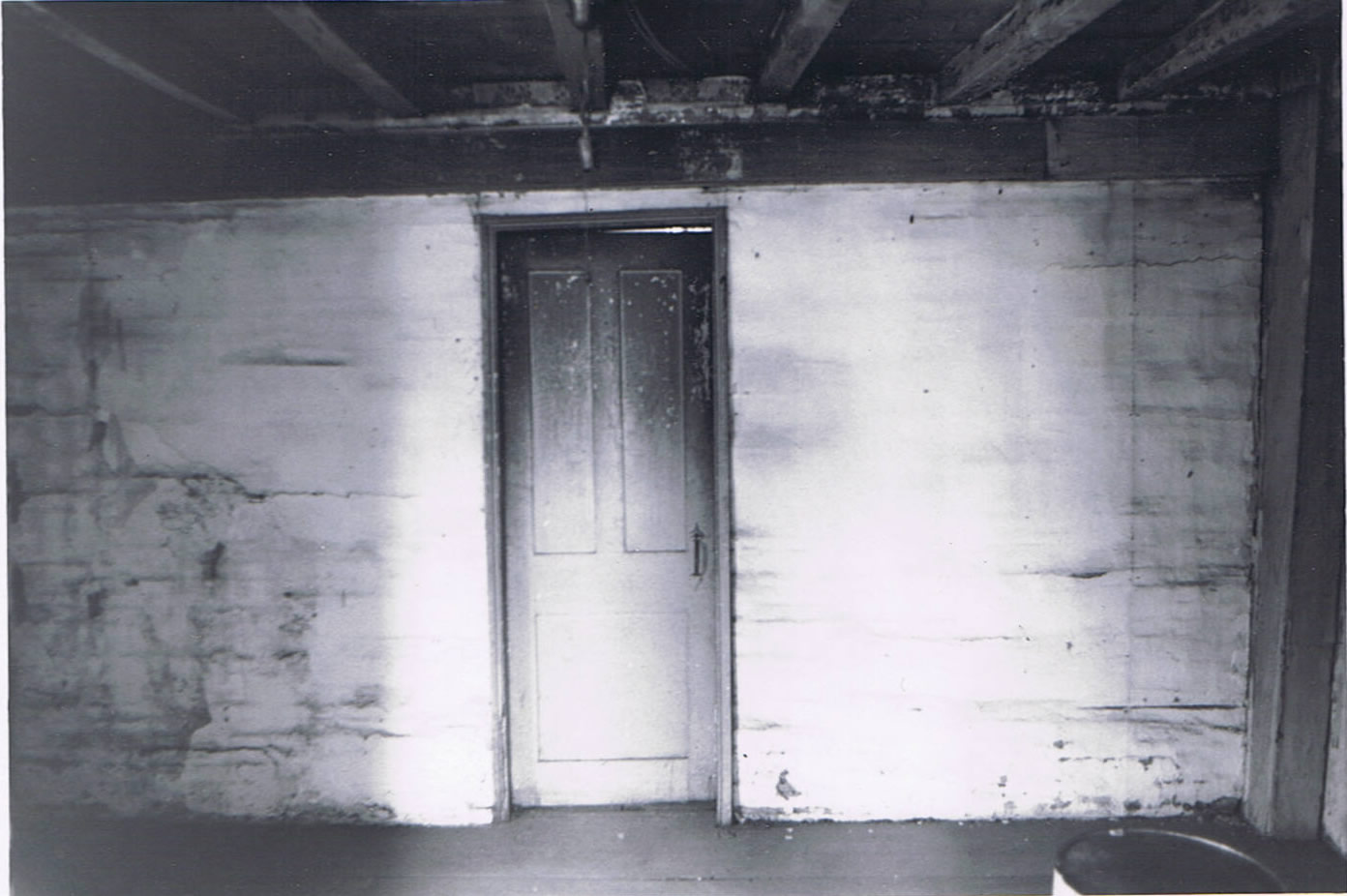
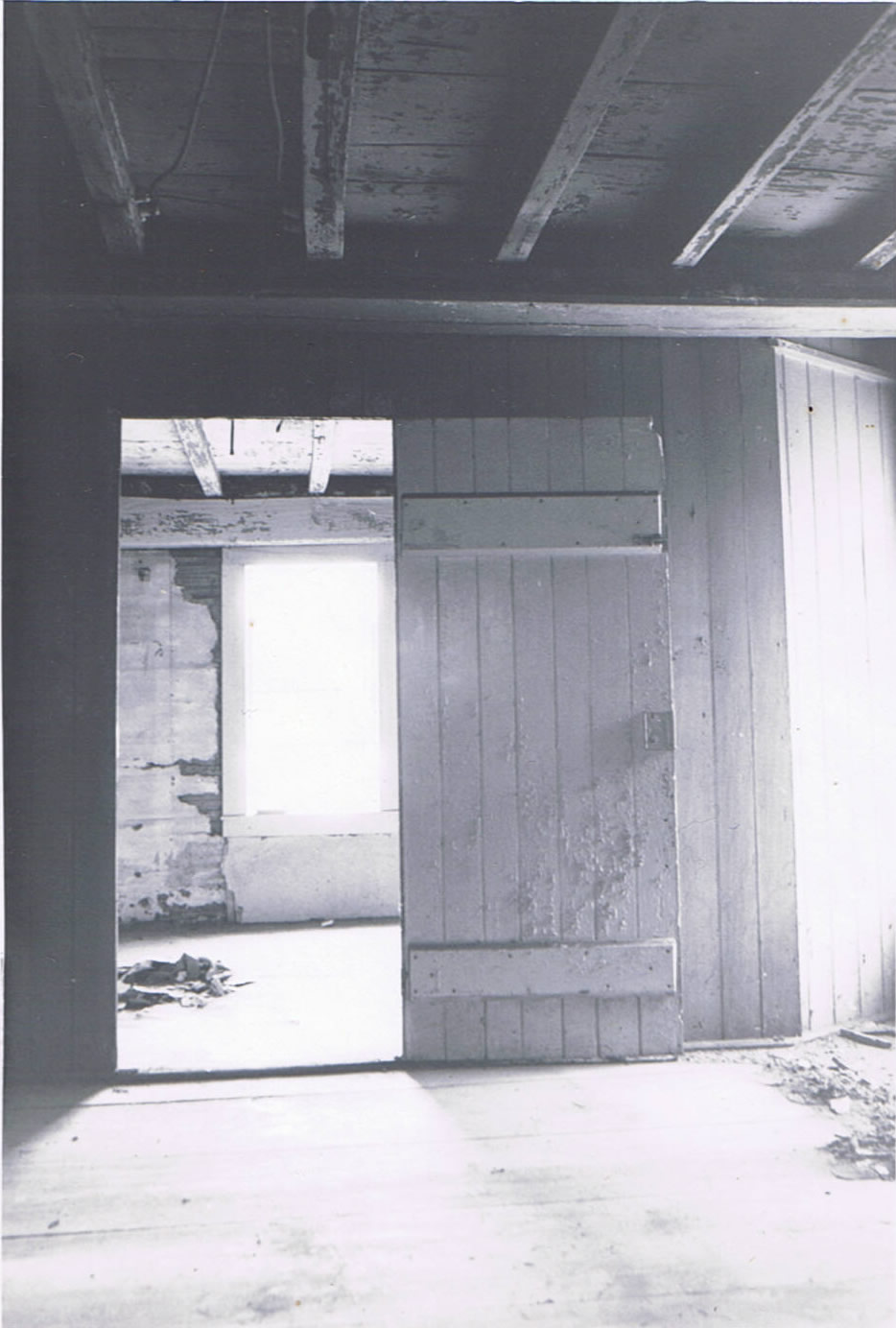
Out with the new – in with the old!  Isn’t that every old house lover’s motto?  In our restoration, anything that post-dated 1800 was the first to go.  Then we’d work our way back selectively.  The front room of the house, the original kitchen, the one with the half demolished chimney in a previous post, had newer sheetrock on the walls, new square trim, base, door and window frames, and a later plaster ceiling.  But we knew what lurked behind.  We removed the ceiling to expose the beams, and ripped the sheetrock from the walls to expose the original feather edge boards that lined the three exterior walls.  Isn’t this gorgeous?

I’m talking about the featherboarding!  As to the youthful, energetic woman in the foreground, well, she’s still the same – on the inside! And still loving those overalls.   Don’t you just hate wearing anything you have to worry about getting paint on?  Or cobwebs or sawdust, or chocolate frosting – I digress…

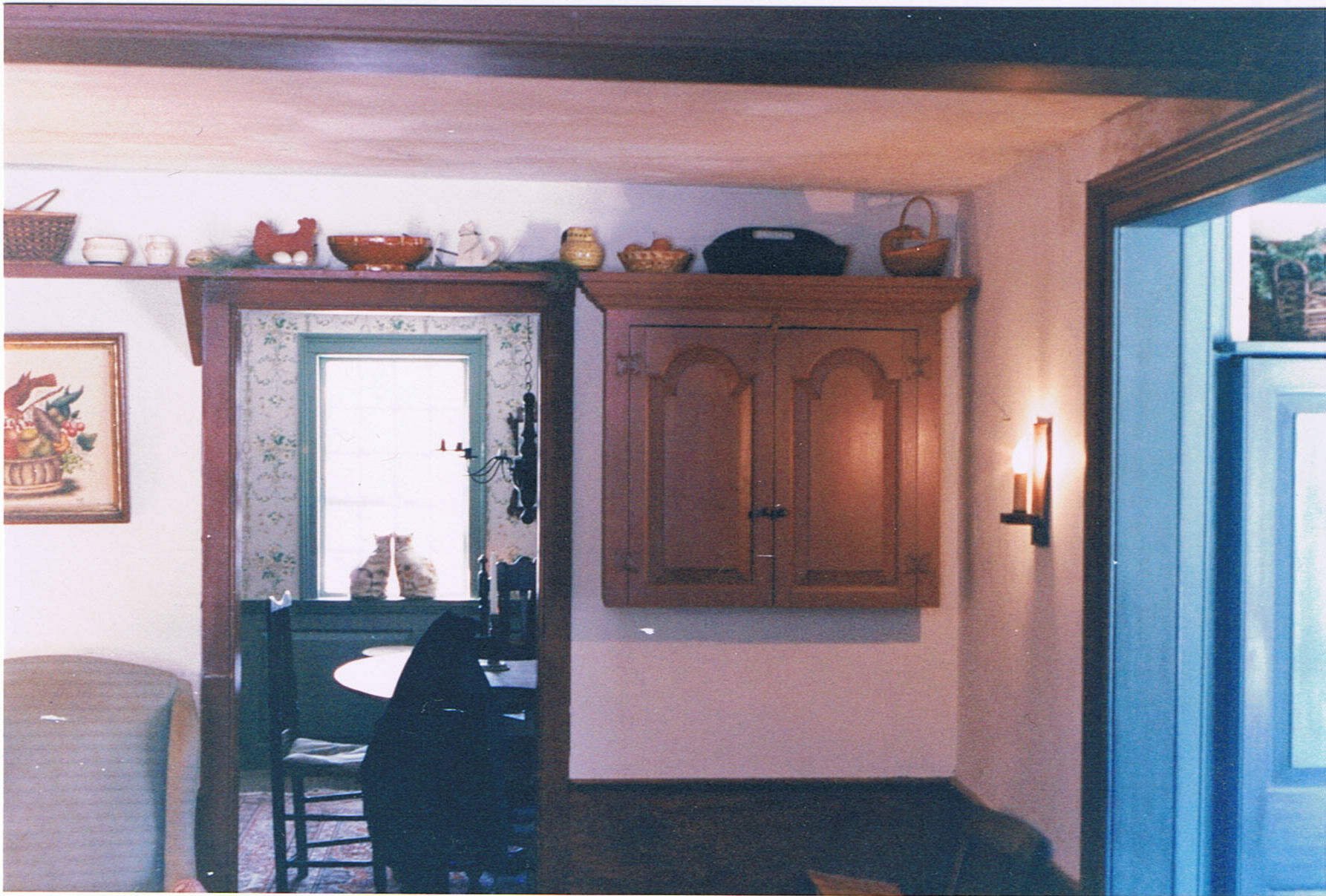
Since I’ve been taking you all down a dusty path, I thought it time for some before and after photos.  At least a sampling to show there was a reward down the road for the years of work.  Here are a few:

kitchen wall - before

kitchen wall after

kitchen fireplace wall - before

new kitchen fireplace wall - after

front room, early kitchen - before

to be continued….

siding

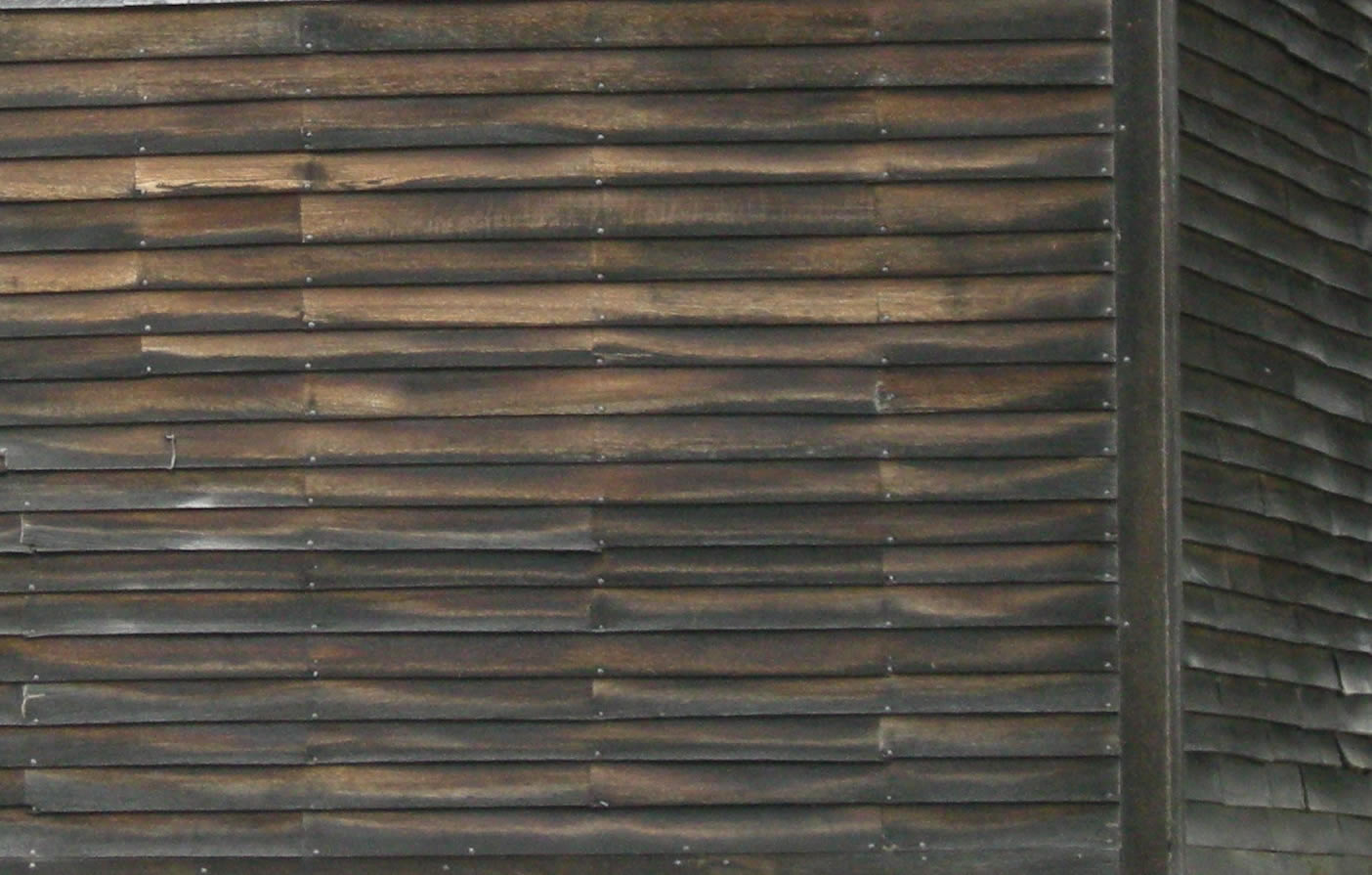
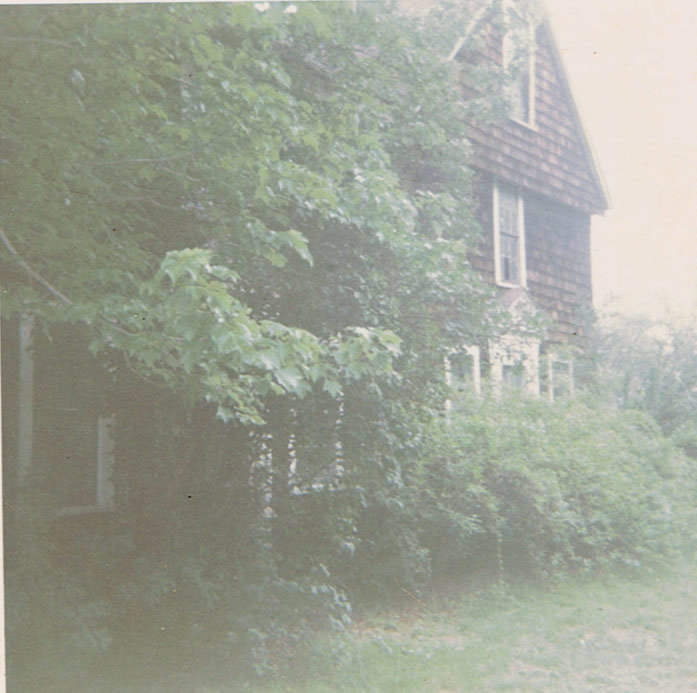
When we first found it, the house was covered with shingles that had weathered a rich, deep, tobacco color.  Unlike houses at the shore, which are almost invariably shingled and turned a silver gray by the salt air, our inland country home in the CT River Valley had weathered the color of its local crop – tobacco.  But shingles were not used inland two hundred years ago.  Oak or pine, sawn into clapboards, would have been the original material of choice.   After visiting the Hempsted house in New London, and falling in love with the siding color and texture, we had a local mill cut rough pine into clapboards for us.  The finished side would face out, by the way, never the rough side.

We then dipped, or soaked, the first batch of shorter lengths in a big barrel of the witches brew we had learned about at the Hempsted house.  We affixed the short, scarfed, clapboards at the back of the lean-to and new bathroom section first.  This ultimately would be the only section on which we used the “brew.”  It would be two years before we got to siding the rest of the house, and by then, the “forbidden” product – creosote – the main ingredient of the “brew” was no longer available.  So, the rest of the house was simply coated with boiled linseed oil, a task we’ve neglected to re-do much over the years.  Somehow, these clapboards have weathered the time and neglect amazingly well, and aged a most beautiful pumpkin, tobacco, and other dark shades of pine in spite of us.  The back side, however, still retains that original charcoal color.

Every clapboard was cut by hand, scarfed one edge over the other, and fastened with a rosehead nail.  I can’t remember where and how we acquired all those nails at the time, they were all antique.  Siding has to be figured and fashioned to fall on a stud in the process, and all of the nails needed to line up, all the way up the house.  Windows and doorways are the exception, but somehow, it works.  There should be symmetry with the line up of the nail pattern, as this will show over the years.  The nails will rust and run and create a line that the eye will see, which only adds character to the unpainted house.

We removed shingles in stages, for the siding process.  When we came to the second floor, we exposed the original insulation – a combination of clay, mud, horse hair, etc. –  called daub. It had apparently been removed over the years in other areas, perhaps when the shingles were installed, but left here, probably for the same reason we would decide to leave it.  It was set in so tightly between the framework, it seemed to be doing its job quite nicely, and the fact that it was original, was another treasure to us.  Why not leave it?  Even though it would be covered over, we would enjoy knowing that that much more of the original house was still in tact.  Another original piece, made right here, from Jacob and Abigail’s earth, even from their horses!  Hmmm…I wonder if their original horse can be cloned using the DNA from some of this hair?  I’ll have to leave that wonder for a few generations next!

restoration- the chimney

Most of us take lots of photos when working on a project, to document the progress, to later compare the before and after.  In the case that you might want to write about it someday, I highly recommend dating them, then storing and organizing them in something other than shoe boxes, bags and drawers.  My photos are as scattered as I am, and my time filled with too many distractions.  Memory serves pretty well, but there’s nothing like turning over that photo and finding the date and situation noted.

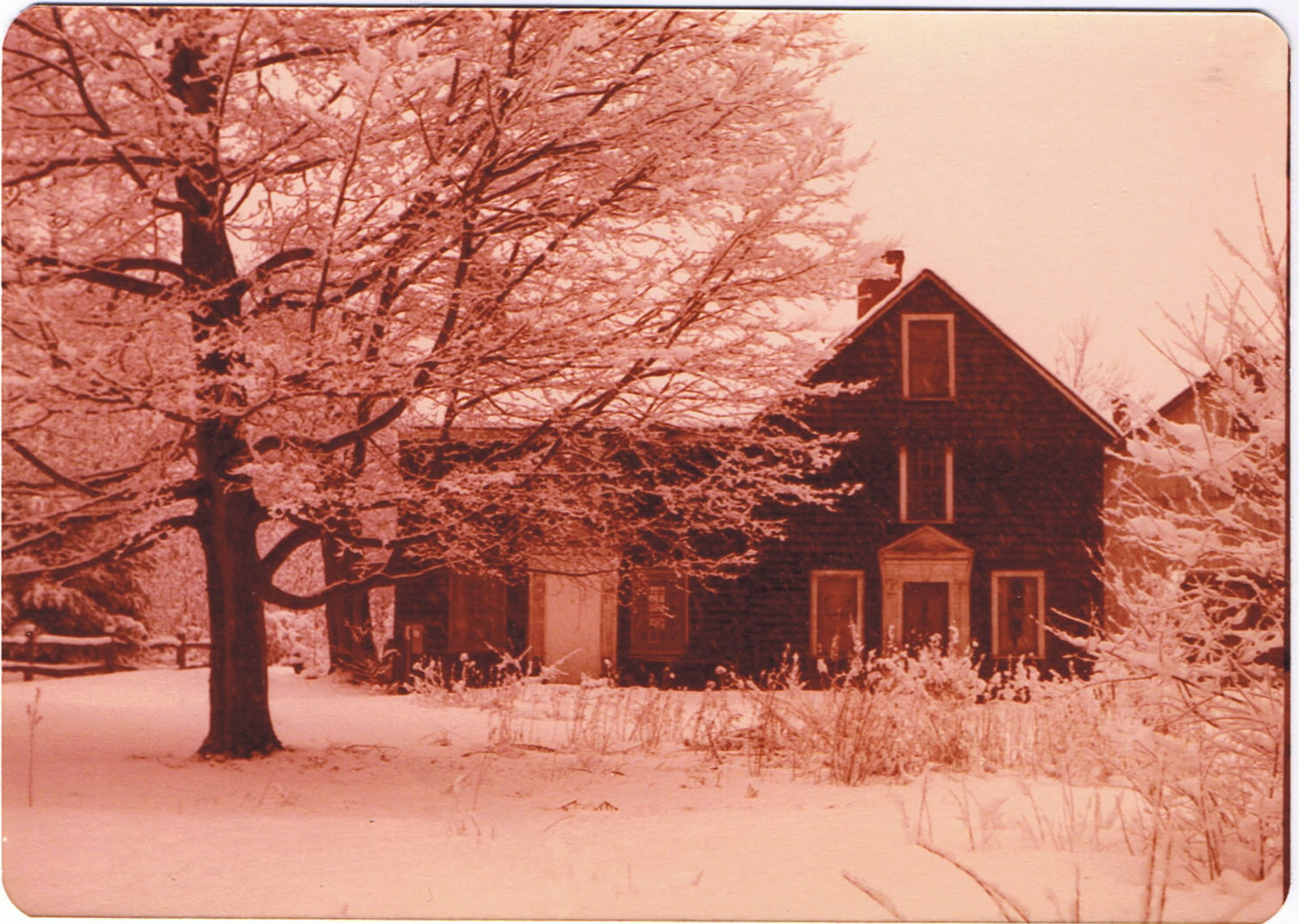
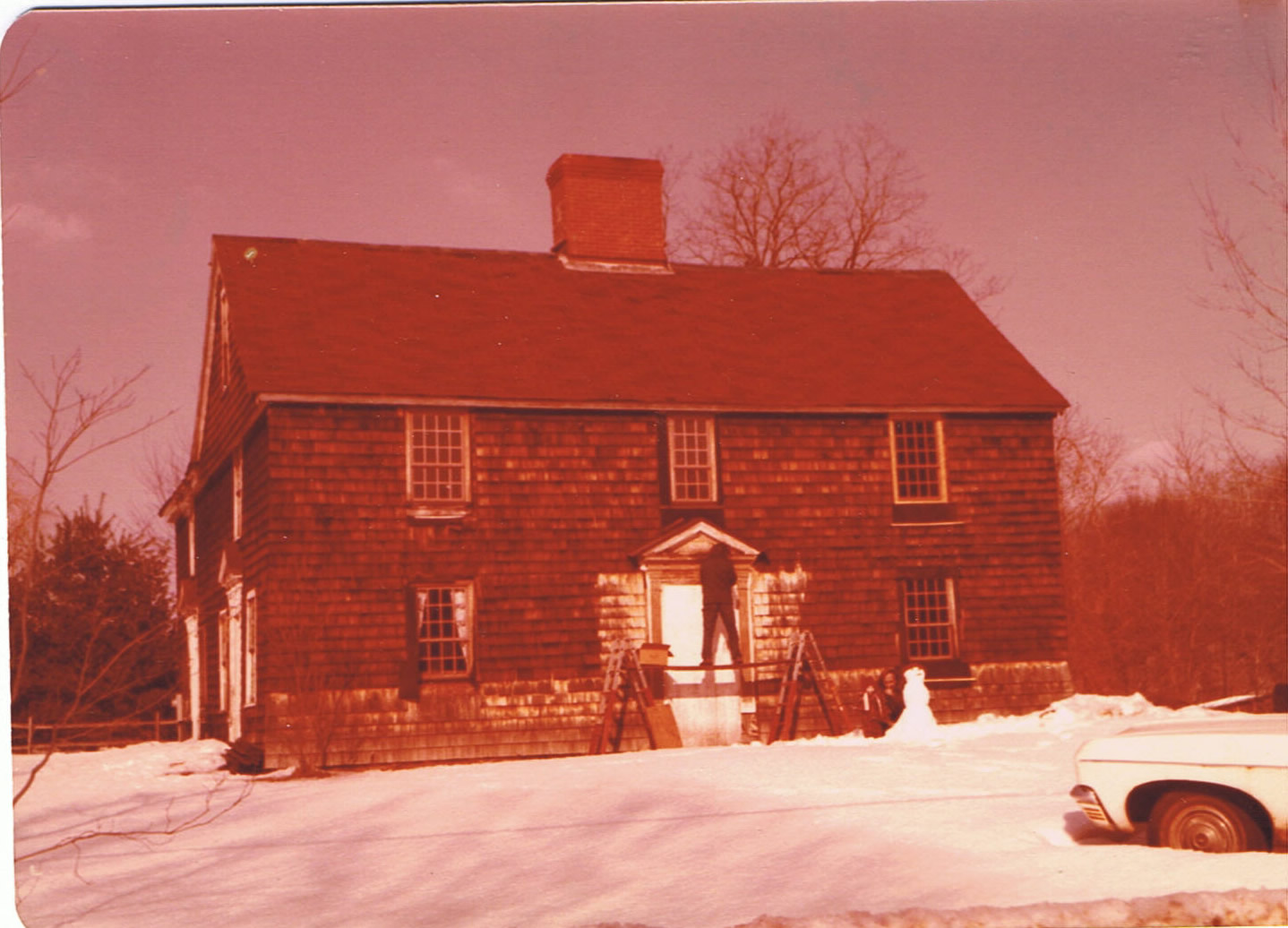
Here’s one, of the front of the house, after our two year hiatus.  We had returned from sunny California into a New England blizzard.  But that didn’t stop Edward from setting up outside the front doorway to tend to repairs.  The front hallway of our 1698 house originally had no windows, the side lights were added in the 1800’s.  We removed them, and re-shingled to match the existing siding.  This was a temporary fix, as we would be re-siding the entire house soon with pine clapboards.  This photo shows the windows already replaced with 12/12’s and the chimney rebuilt.  A Yankee carpenter who worked out of a small country lumberyard in the neighboring hills made these for us.  His shop was tiny, but efficient.  The twelve by twenty foot room was lined with benches, hung with tools, and heated with a wood stove.  Wood scrapings and sawdust lined the floor.  A table saw sat in the center, and Fred ruled it all.  He was a woodworker, a blacksmith,  a dowser.  He was one of those Yankees who could fix anything, and if he couldn’t, it probably wasn’t worth fixing.  He was one of those rare gentle men who valued tradition,  and doing things the old fashioned way.  He would visit later, to help us find water – the old fashioned way.

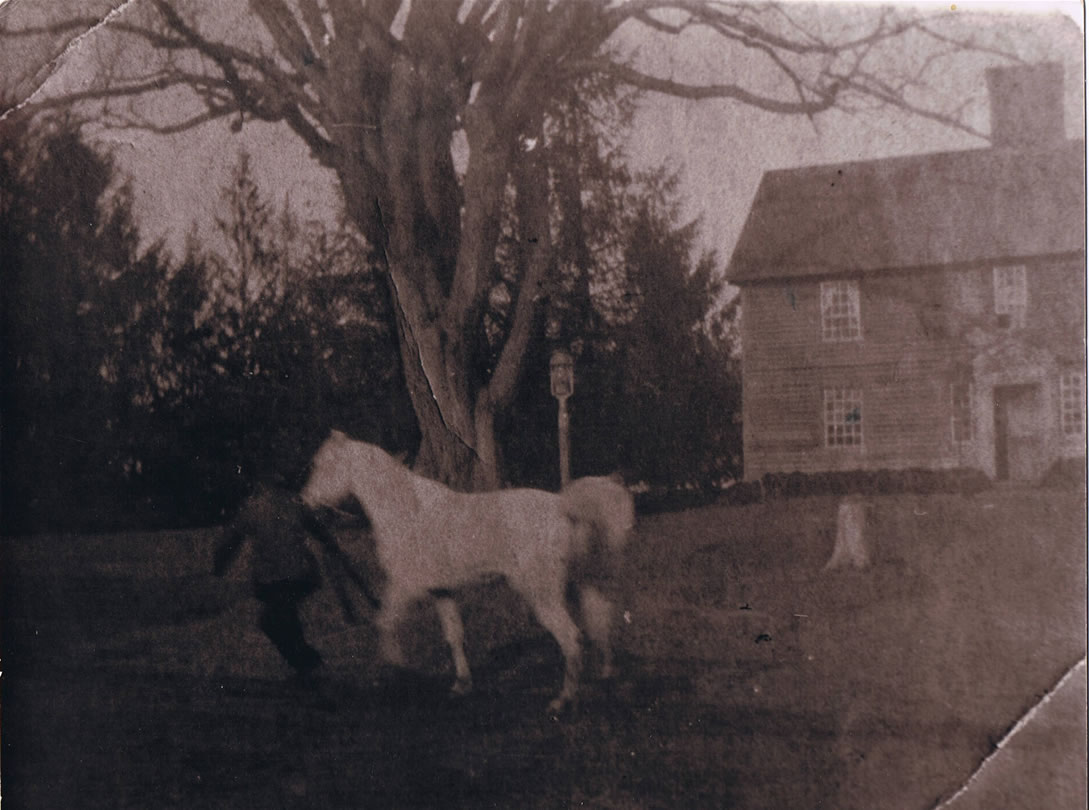
Below are some photos of the fireplaces and chimney restoration/rebuild.  Finding a mason for this was serendipity.  A total stranger stopped by one day who said he was a mason who worked only on old fireplaces and chimneys.  He said he could make it look just like it used to, he had some tricks to make it look old.  And yes, he could build a bee hive oven.  To top it off, of the four family names that had previously owned this old homestead in the last 250 years – his was one of them.  Quite a coincidence.  However, he personally hailed from Maine.  We took a chance, pushed for the details we wanted, maintaining as much of the original integrity as possible.  Most important were tight joints and a hearth that was not mortared in, just laid tight.  We specified the height and width of the chimney as it came through the roof.  We were incredibly fortunate to have photos of the house that were taken in 1888 showing its original exterior features – chimneys, doors, and pedimented 12/12 windows.

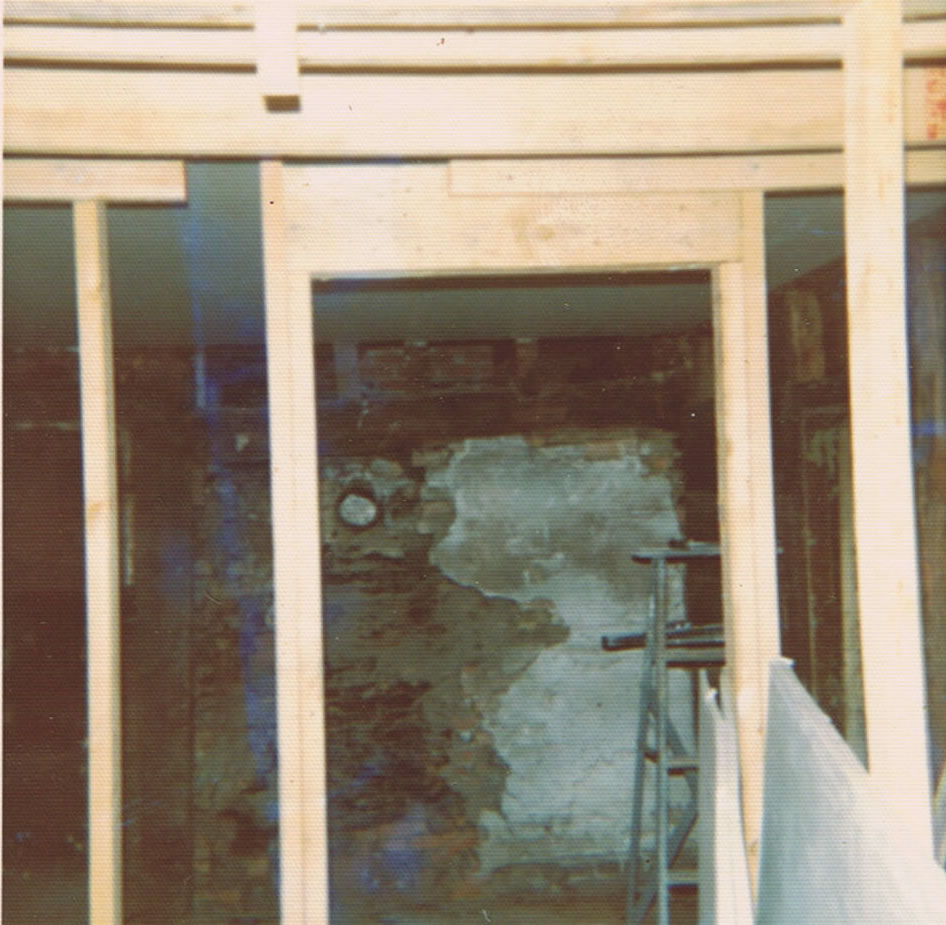
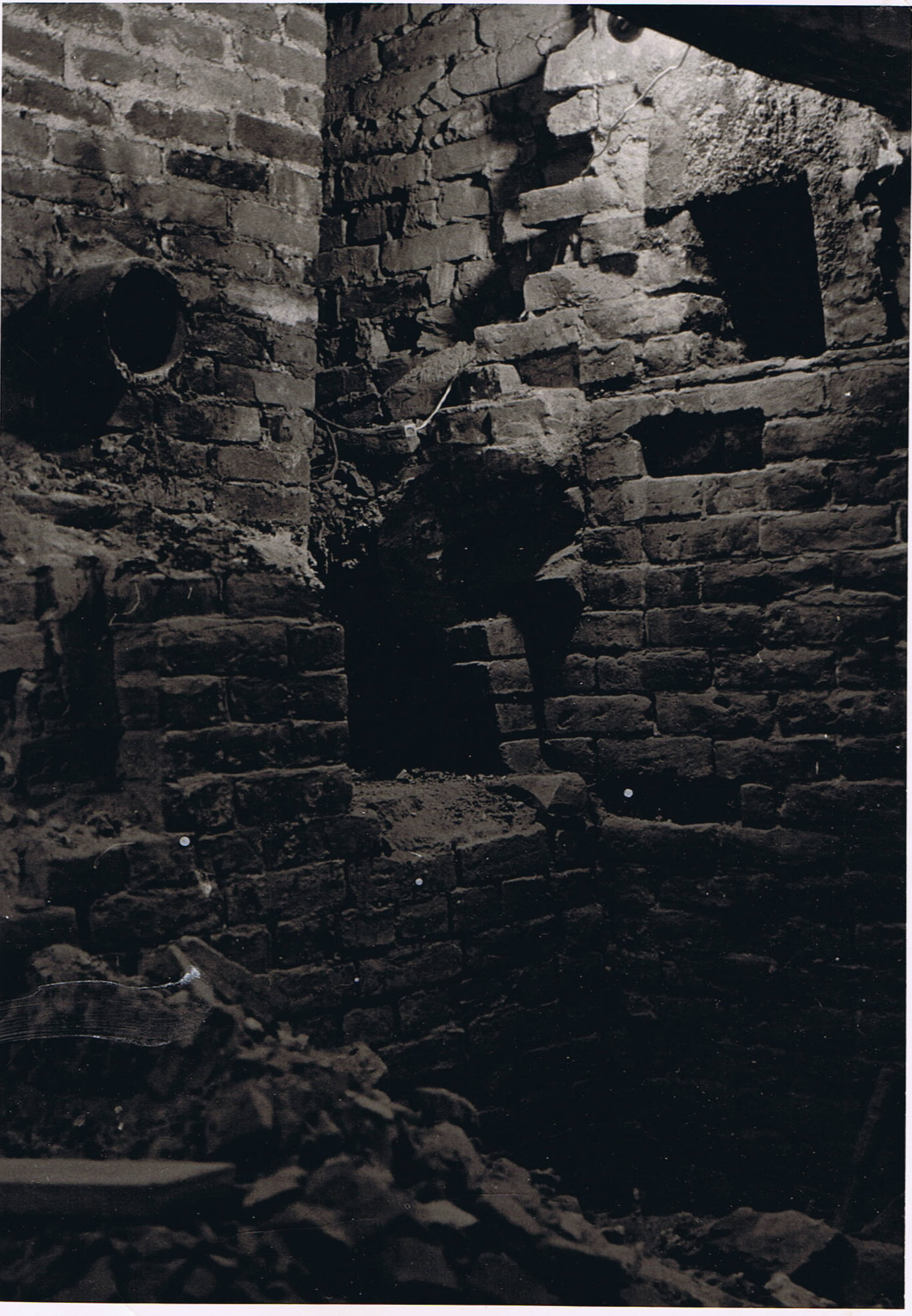
There had been a chimney fire at the second floor fifty years earlier when the bachelor homeowner decided to do his Spring cleaning by burning everything he didn’t want, in the fireplace.  There is still charring on the mantel and summer above.  The second floor fireplace had been lost and the larger chimney rebuilt smaller to accommodate the wood stoves.  Also, smaller fireplaces were laid up in front of the larger ones at the first floor.  When we removed the walls to begin the chimney work, we discovered parts of the larger fireplaces still existed, and their side walls still in tact.  In this photo you can see a little cubby that was built into the side wall, the bake oven and smoke ledge.  We were pretty excited.

Here, you can see through to the other front room.  It was quite a mess, and quite a task.  It was pretty funny.  Actually, the whole process, messy as it was, was a lot of fun.  The mason, as it turned out, was quite the trickster and our days were filled with stories of his pranks.  We should have been worried that he’d tricked us, but as he worked, we could see that he knew his trade.  Here’s a photo of his building the bake oven.  He filled the ledge with sand and mounded it into beehive shape to form the top of the oven.

And another, showing what goes on inside the chimney as it goes up. Cinder blocks are used where it doesn’t show, and can be plastered/mortared over. The clay liner is the flue for the furnace, while brick flues are built for the other three fireplaces. Here he is approaching the second floor. I apologize for the quality of these old polaroids.

We did find treasures, nothing that would pay for the restoration, but something to excite us through it – that touch with the past that one who loves old houses is always looking for. We knew the house had been built in 1698, the year that Jacob married Abigail. And we knew the names of their children. We knew that the bricks had been made locally, probably right in the yard beside the brook. We found many bricks with writing scratched into them, by the homeowners and their children, probably as they were curing by the brook. Jacob’s name was scratched into one brick, and Abigail’s in another. One was deeply cut into, as though with a finger, with the name “Mindwell,” their daughter. One said “welcome,” another had a paw print, and we found one half of a brick with the number sixteen etched into it, but never the other half. We laid these reminders of whose house this really is, and will always be, into the hearths.

restoration

Be careful what you wish for, right?  Sometimes we run headlong toward a dream only to crash into reality.  Fortunately, we were young, energized, and eager to tackle the job when it happened.  I couldn’t wait to rip everything out of that house that didn’t belong.  Beaverboard covered beamed ceilings and featherboard walls.  Newer, shallower fireplaces covered deeper ancient ones, wallpaper covered paneling – and black soot covered everything.  There was a huge coal fired cooking stove in almost every room, with the familiar hole cut out of original paneling to vent it.   Floors were bowed, and original boards lost at the first floor – that awful narrow tongue and groove replaced them.  Even those were painted and rotted.  In every room the floors leaned toward their sills, which were obviously termite ridden.  There were three magnificent doorways on the house, but their original doors were missing.  All of the windows were replaced with six over six’s.  They were made larger, which cut into the interior woodwork.

There was no heat or plumbing or electric.  But that wouldn’t deter us.  There were treasures to uncover.  And besides, we had just come from a project where, for a year and a half, we had lived with an outhouse in the woodshed and a pump outside for water.  We could handle this.

With a ten dollar table saw from a neighbor, a few tools and a lot of gumption, the journey began.

Here are some photos I’ve found.  Wish I’d taken more back then – especially with those monster cook stoves – which a local flea market merchant was so kind to take off our hands.  No easy task, moving those behemoths.
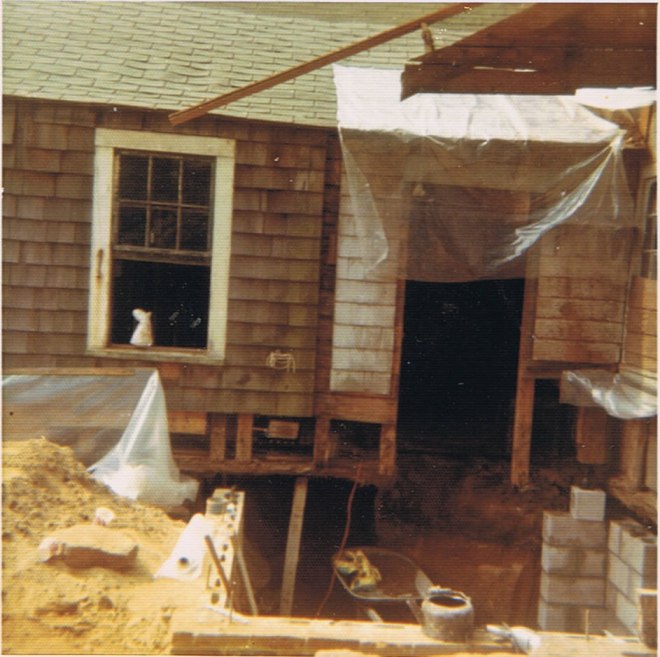
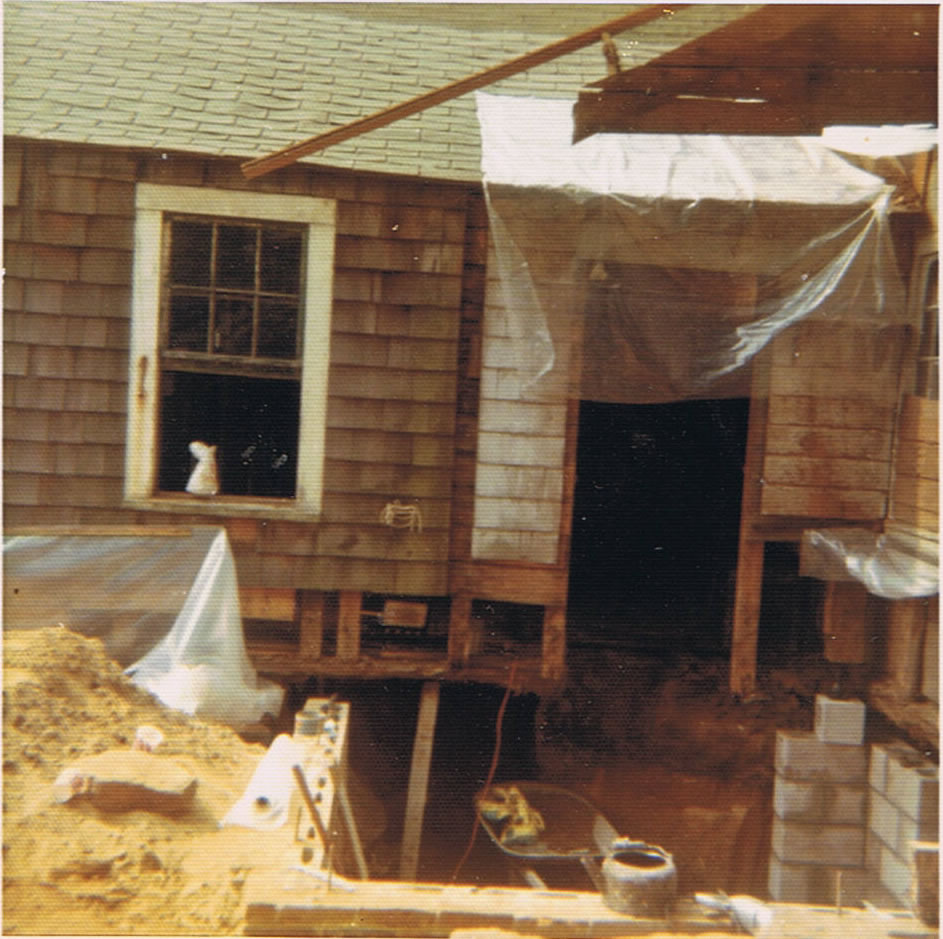
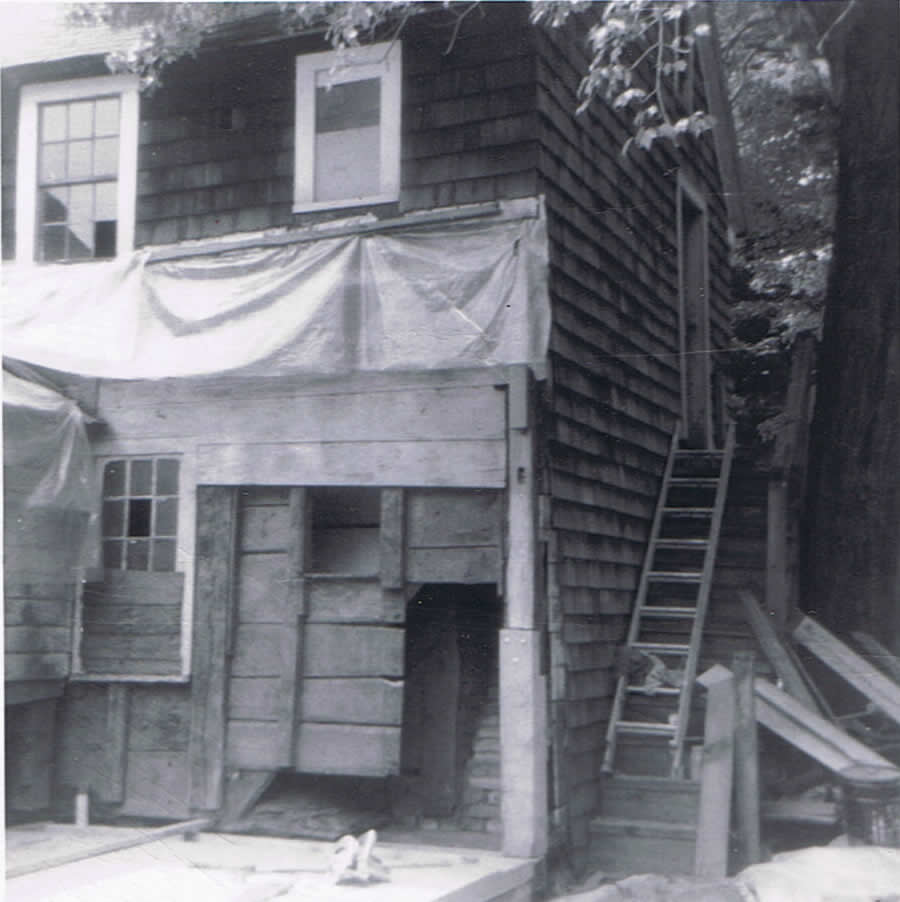
One of the first things we had to put in was, of course, a bathroom.  Since our budget didn’t allow for much more than purchasing the house, we would have to do everything.  By hand.  Here is a shot of the back of the house after taking down the later woodshed.  Yes, we’d be going out to the woodshed again, to use the bathroom.  But at least this one would be attached and have running water.  The big hole in the ground was dug by hand, by Edward, with a little help from a friend.  Then he constructed the cinder block foundation, block by mortared block.  No matter how much progress you think you’re making with an old house, sometimes, it seems there are as many steps in reverse.  The more you uncover, the more work you see ahead of you.  Another sill, or rotted post, and everything being connected – another stud to replace, or joist rotted at the end, or girt whose rafters no longer reach…and on it goes.

Thank God for the treasures!  And the youth.  This photo shows the hole covered and deck on, and the exterior wall of the original 1720 two story ell.   A picture’s worth a thousand words – but I’ll probably say them anyway.
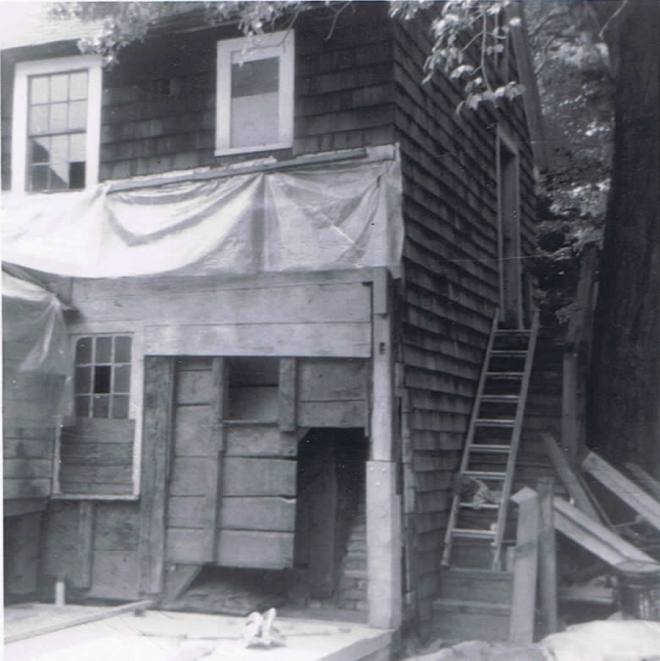
The stair at the back of the house was for one of the many “renters” who lived here over the years.  Through the wall sheathing you can see the the back of the original chimney and a bit of the construction of the interior back stair.  My favorite part of the whole house – a narrow two panel door in the paneling leads to this primitive back stair with exposed and whitewashed studs and joists.  As as you wind up the stair, there’s a landing with a built in bookcase which has aged a deep chestnut color.  And on the featherboard wall beside it, there is faded writing, some of which says “war of 1776.” This entire stairwell area is lit by a casement window, boarded up in the photo. Years later, this stair is how our little one would get to her room at night.  Instead of candles as in the 18th century, she used a flashlight.

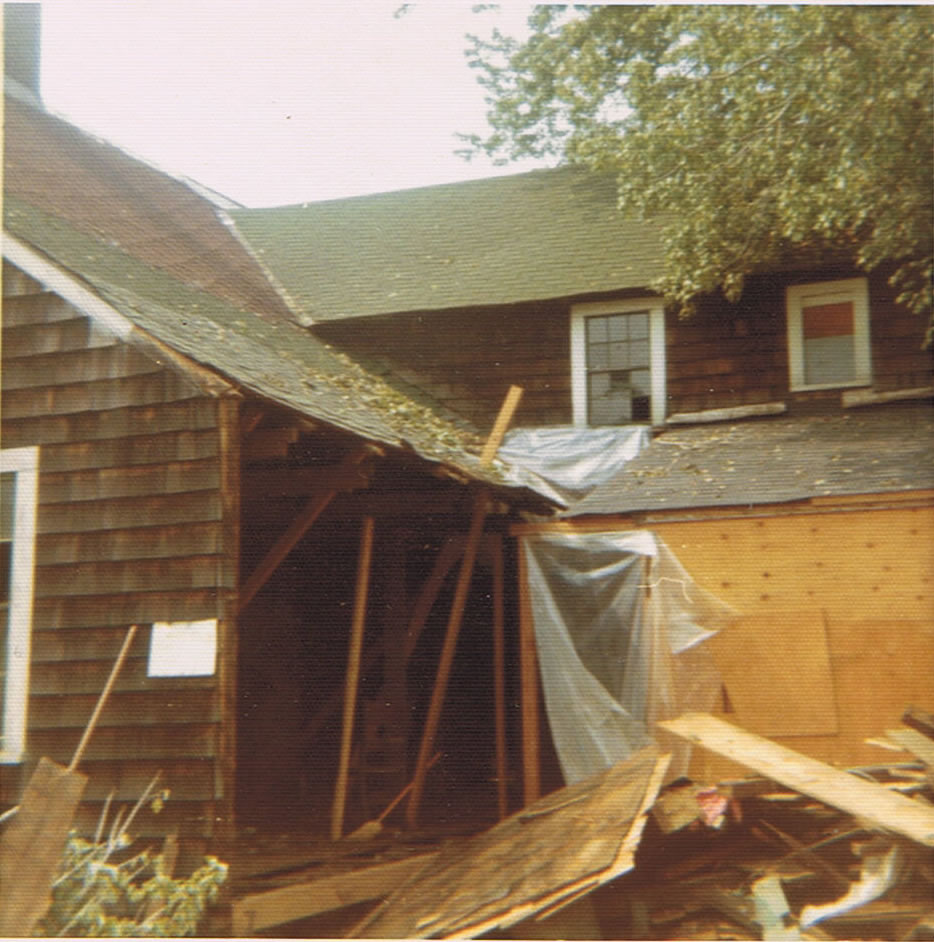
As I said, one thing leads to another.  Not until you uncover it all, do you see the extent of the work.  Here is the back wall of the lean-to section of the house.  By the way, the original two story section of the house was built in 1698, the two story ell was erected in 1720 (we found writing on the joists) and discovered the timbers were re-used, they came from an earlier house.  And the lean-to, that makes it a saltbox on one side, was put on around 1760.  Meanwhile, we had to remove the entire back wall, replace the girt, re-engage the joists into the new one, replace the sill, and re-stud.
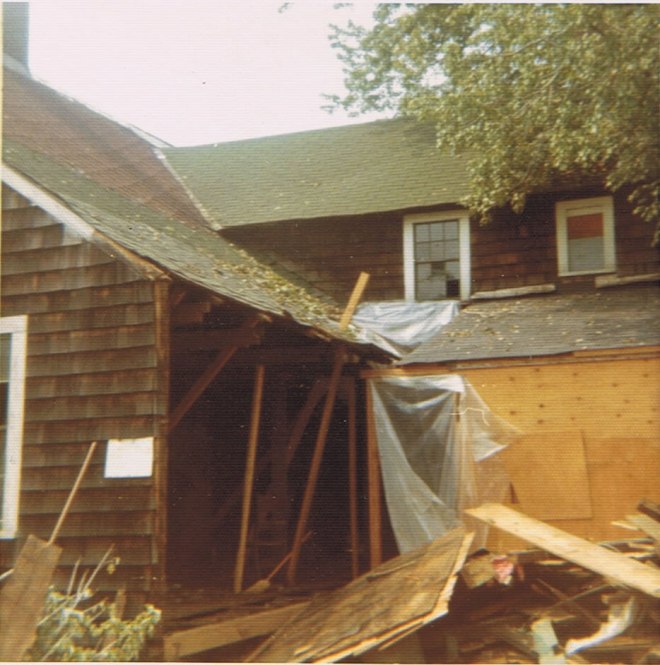
One scary event – this wall was open, with plastic covering it overnight.  We were away – and a tornado came through our neck of the woods that day.  We thought there’d be nothing left – but fortunately it missed us.  I know – it looks like it hit us!
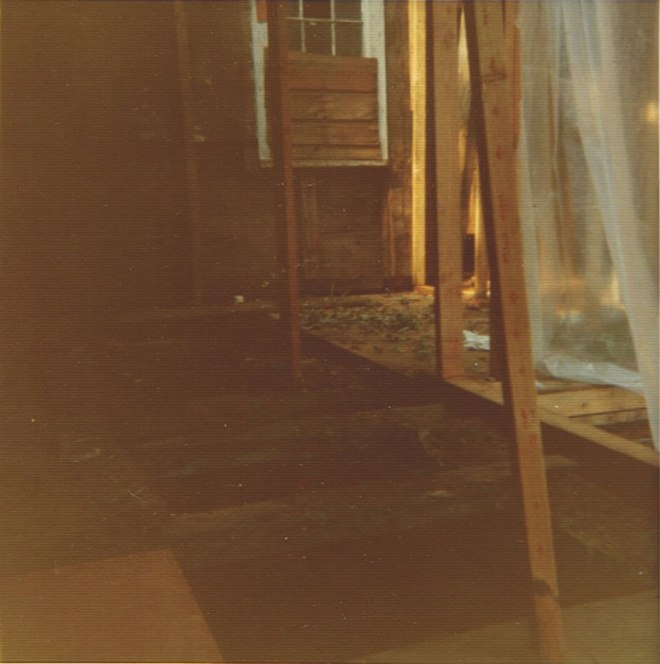
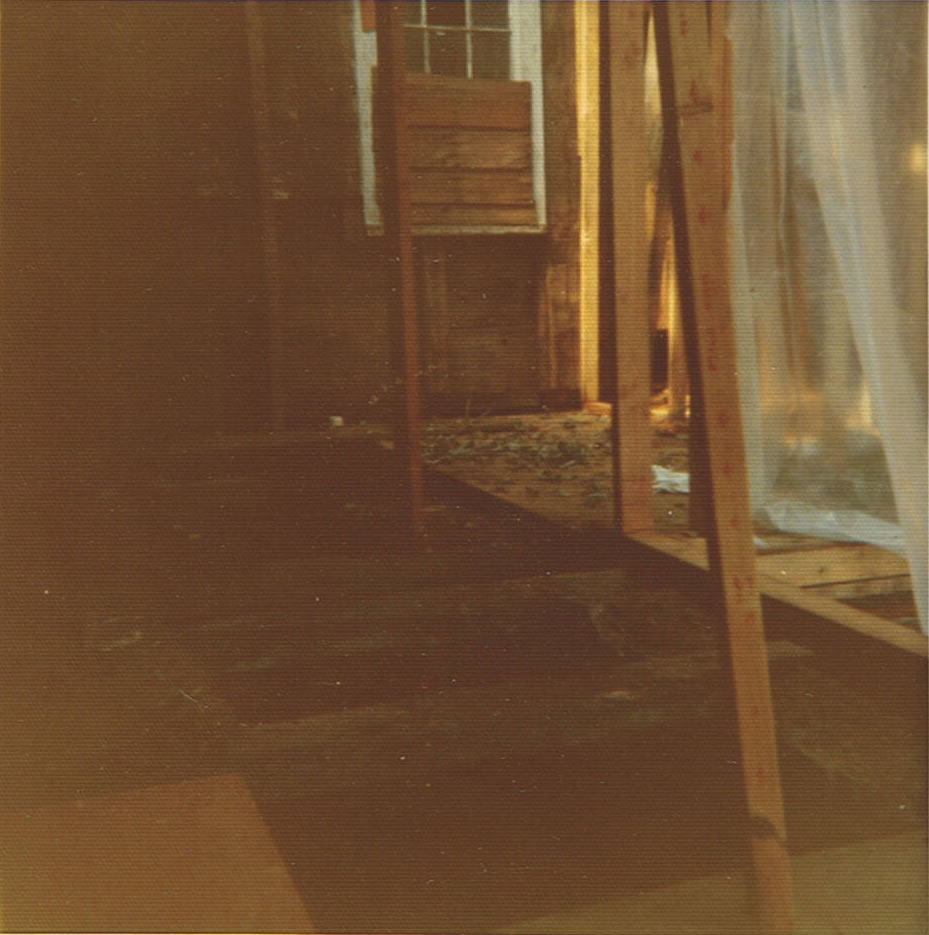
The hole where our future kitchen will be.
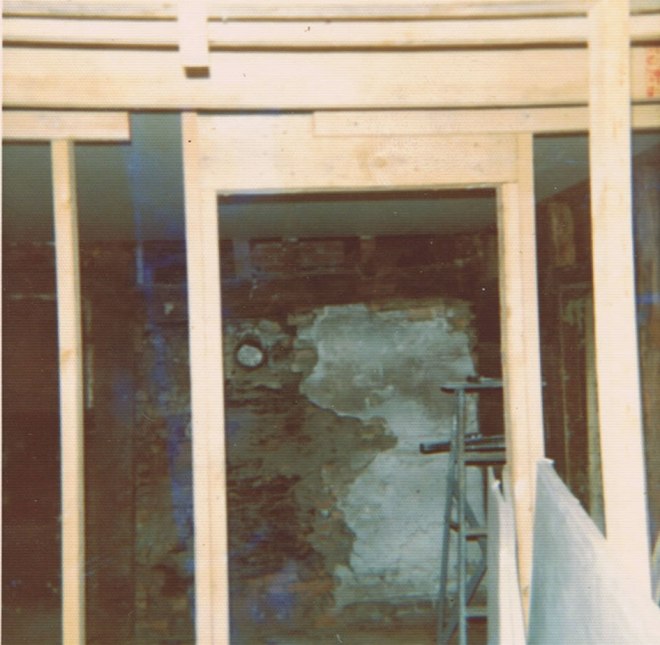
Another hole for – guess what?  We would add a small kitchen fireplace here, and a paneled wall.

More interior shots.  We have our work cut out for us.

1720 addition

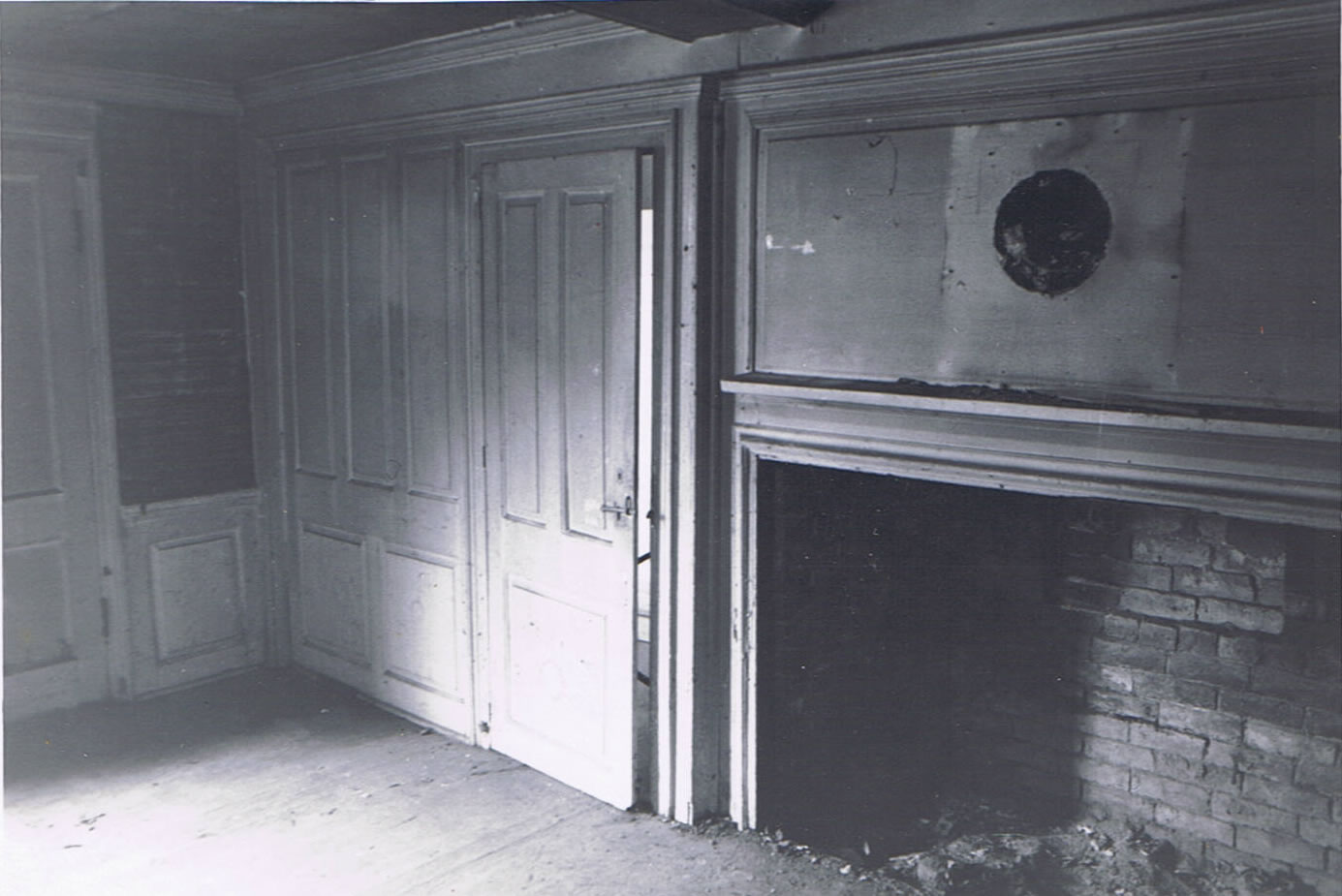
Original paneling, with a hole where that darn stove was vented.  To the right of this fireplace is the door to the “secret” stair.
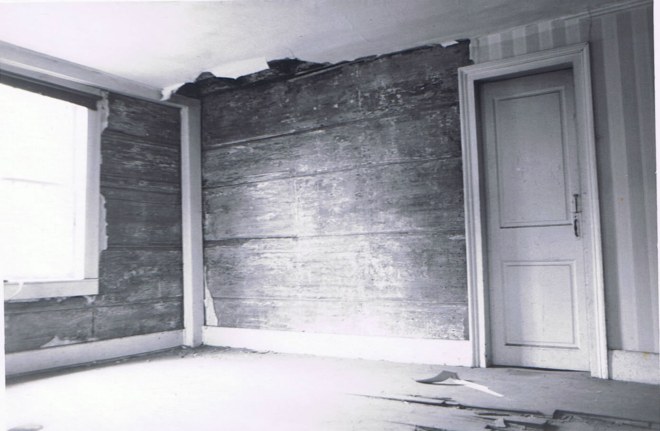
A section of the room that was the original kitchen.  We’ve removed that old beaver board (forerunner to sheetrock) to expose original horizontal featherboards.

And upstairs:
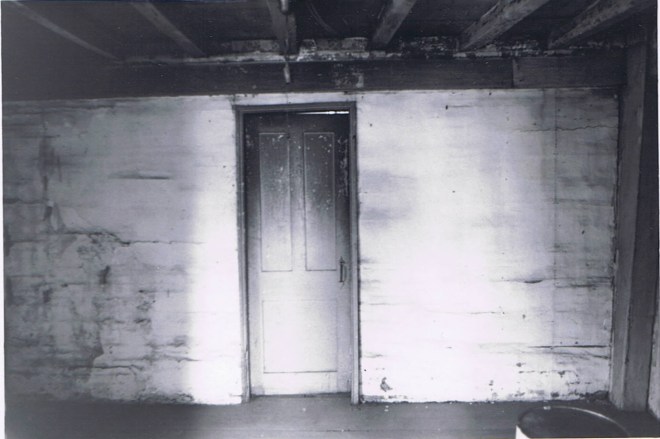
I love this shot.  This is the upstairs front bedroom.  It had been divided into two rooms by this wall which was constructed across it from the fireplace to the window.  They had to slant the wall, as though they’d built it across and then said “oops!”  The original plaster still barely clings to the walls and the whitewashed beams are exposed.  Awesome!
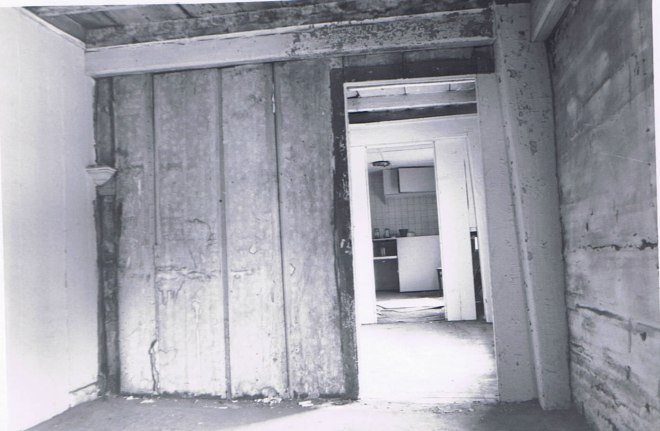
On the left you see the backside of that wall that divided up the room – and the bit of fireplace mantel showing!  Imagine building a wall right into the decorative mantel?!  Note the featherboarding covered with wallpaper – and the gunstock post to the right.  Through the hallway you can see the “apartment” they created in the other front room.  This room also was divided, painted six different colors, and a crude kitchen added.  Here’s an old polaroid I found.
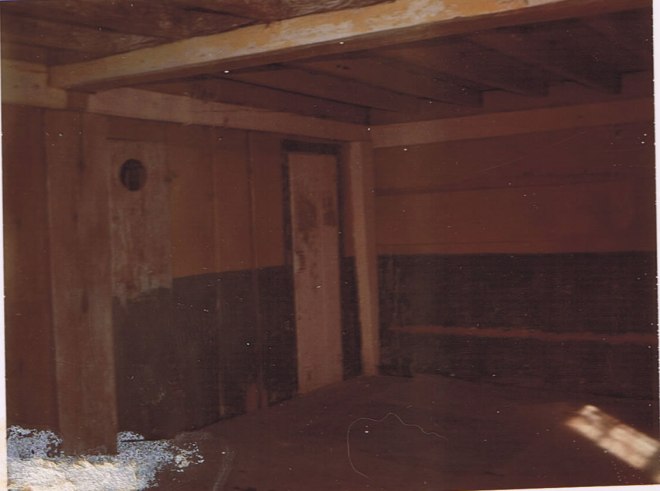
Another room, another stove, another hole.  The room may be pink and green and yellow – but it’s all wood.  Original featherboard doors are still in their places, opening to tiny closet spaces.  The original flooring at the second floor is big and beautiful and wide, and serves as the ceiling of the first floor below.

And all of this, the heaviest, dirtiest work, Edward did alone.  I was working during the day to help buy materials, and food for the project.  Then nights and weekends were my turn.  He was still an aspiring musician/songwriter, and that future hit song was going to pay for the rest of this restoration!  Those were the days.  One of the many travels in pursuit of a music career took us to London – right after we bought the house.  We (and the band) came back with a record deal several months later, well, it was the promise of a deal – with just some fine print to work out.  Two weeks after our return, they called to say they could sign only one act right now – and decided to go with an obscure band from Texas – by the name of ZZ Top.

After two more years, spent in Los Angeles, and some interesting times, we came back with our infant daughter, and resumed the restoration – without the help of that million-dollar hit single.  Instead, LA handed us another “almost.”  While there, the manager spent the advance money, which was to record that single, on a house for himself.  It’s a long story.

Needless to say, this old house business was looking like a worthwhile career.   We began to do this work for others as well.  The rhythm and balance of art and music would serve us well over the years, incorporated into the design and restoration of 18th century architecture.   After all, like Goethe said –  “Architecture is frozen music.”

in the beginning

Well, not the beginning, but rather the start of the restoration of our own house.  I thought I’d share in a series of entries here, some photos and info on the work of it, which also took place at the beginning of time, or so it seems.  We were in our early twenties, and, surprisingly in counting back, it was our fifth house project.  My husband happened upon it one day, and of course, like a magnet, was attracted to its lines, its center chimney, doorways, and the sixth sense that told him it was empty.  Trespass, when it comes to old houses and helping them, is a risk, but a necessity.

After walking around it squinting through windows for a time, he heard the sound of a tractor behind him, and realized he was about to have to explain himself.  The farmer wearing a broad hat and baggy overalls, pulled up right onto the front lawn, turned off the engine, leaned over the wheel of the tractor, and gave him a stern look.

Edward was always charming, smart, and kind.  But in his youth complained that adults didn’t take him seriously because of his long hair and musician look.  His mom would always assure him then that as soon as he spoke, they’d see beyond his looks.  And she was right.

But would it work with an angry farmer?  Edward was passionate, sincere, and believable.  He was truthful.  But this farmer wasn’t buying it, at first.  He didn’t take out a gun, but his huge frame and angry scowl was intimidating.  The farmer just couldn’t believe that anyone might have an interest in this broken down old house that he was planning to let the fire department practice on.  Once finally convinced that this young man might actually be willing to pay cash for the place, the farmer’s ears perked up, his face brightened, and though in disbelief, his interest was peaked.

After much conversation, meetings and dealings, and in spite of the fact that the house looked on the inside like it had already been in a fire – we ended up with that crooked, broken down, dilapidated old place.  The farmer would continually scratch his head, feel guilty about selling it to us, and for years drive over in that tractor with a bushel of squash or cucumbers, homemade sauerkraut, even maple saplings from the meadow – three of which are planted across the front yard.  Offerings of old timbers from fallen tobacco sheds, which we’d use to replace rotted sills, and numerous other gifts of vegetables and Yankee tales, would sustain and entertain us for years.

Happy Holidays!

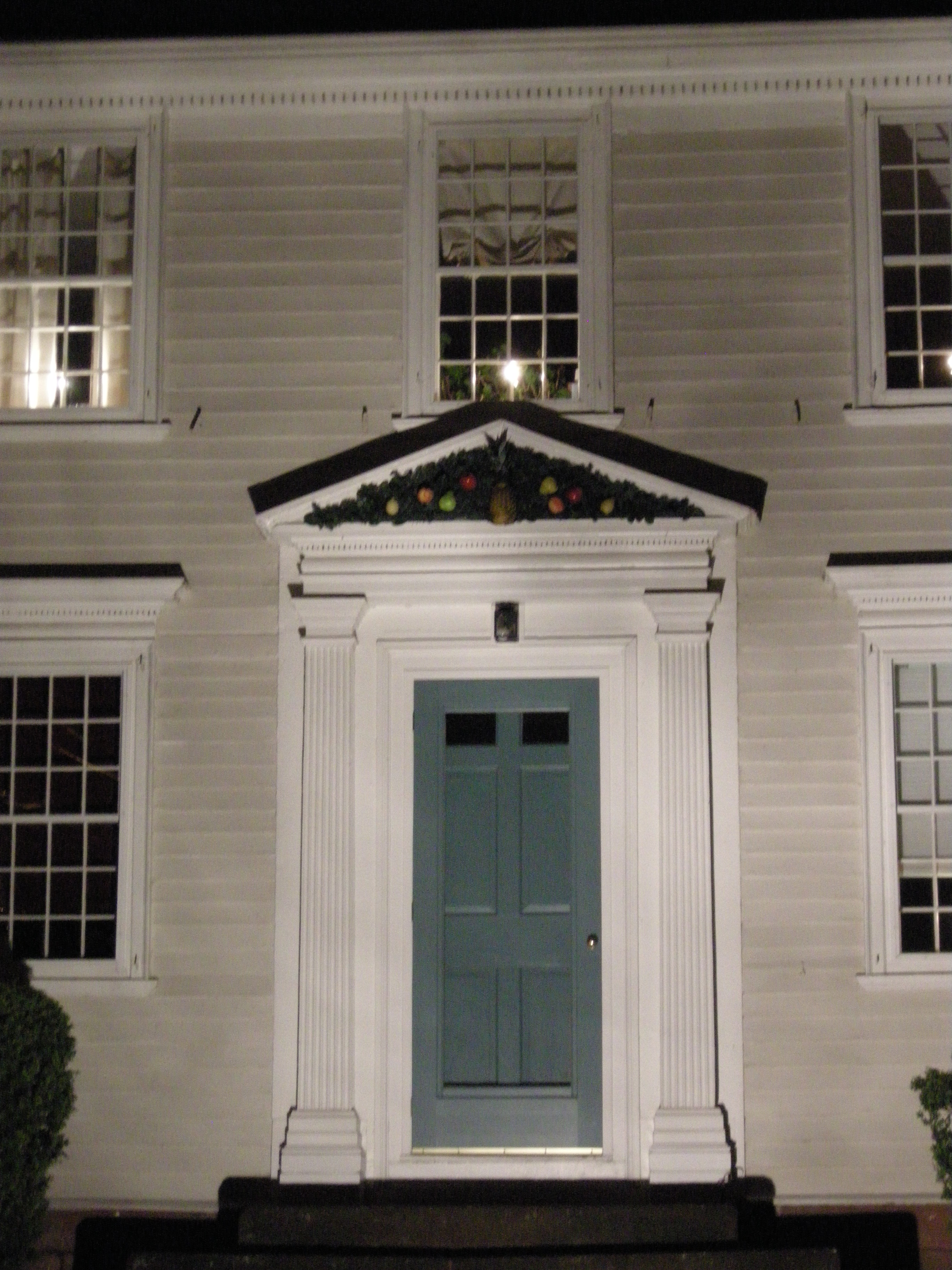
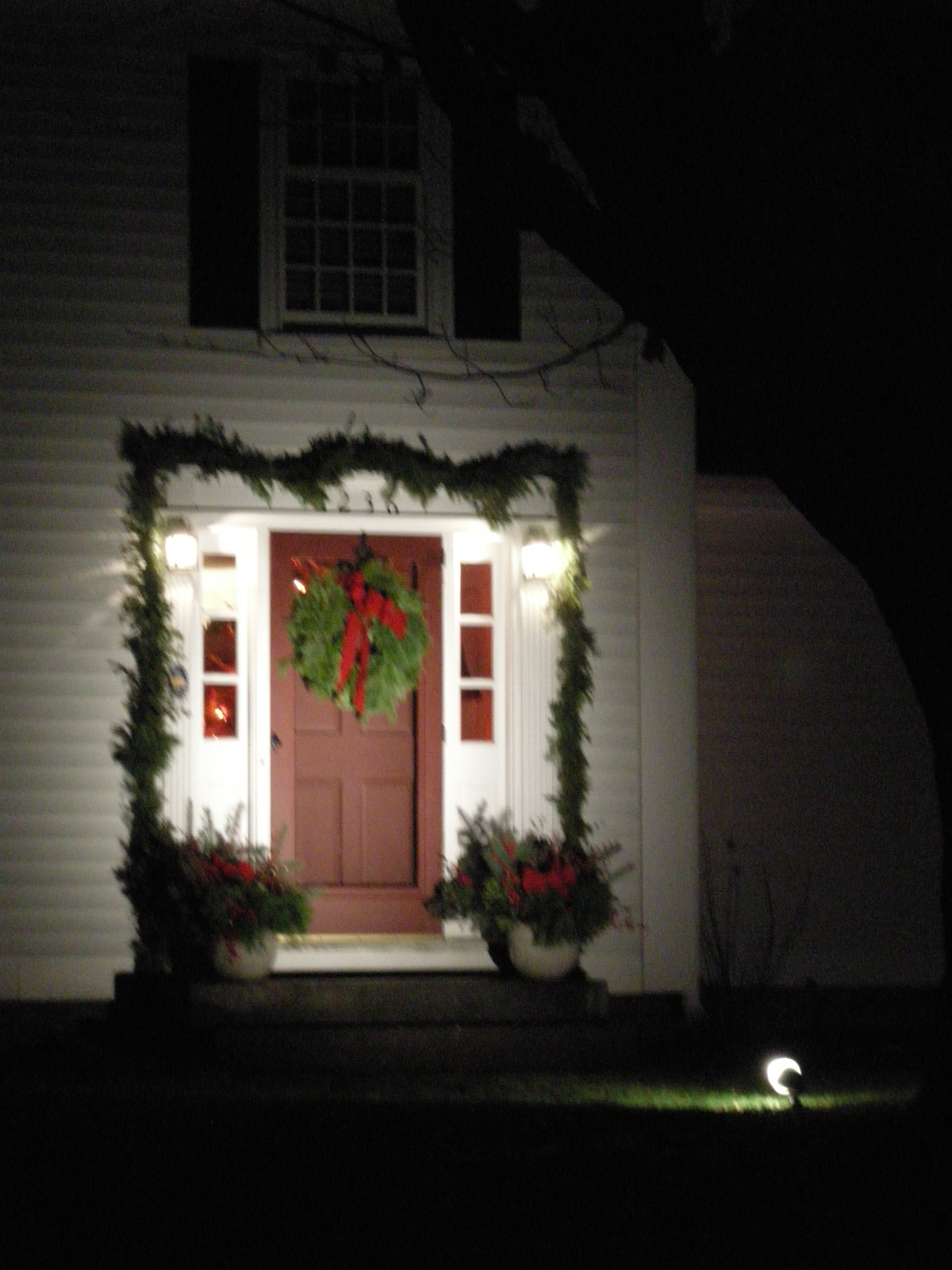
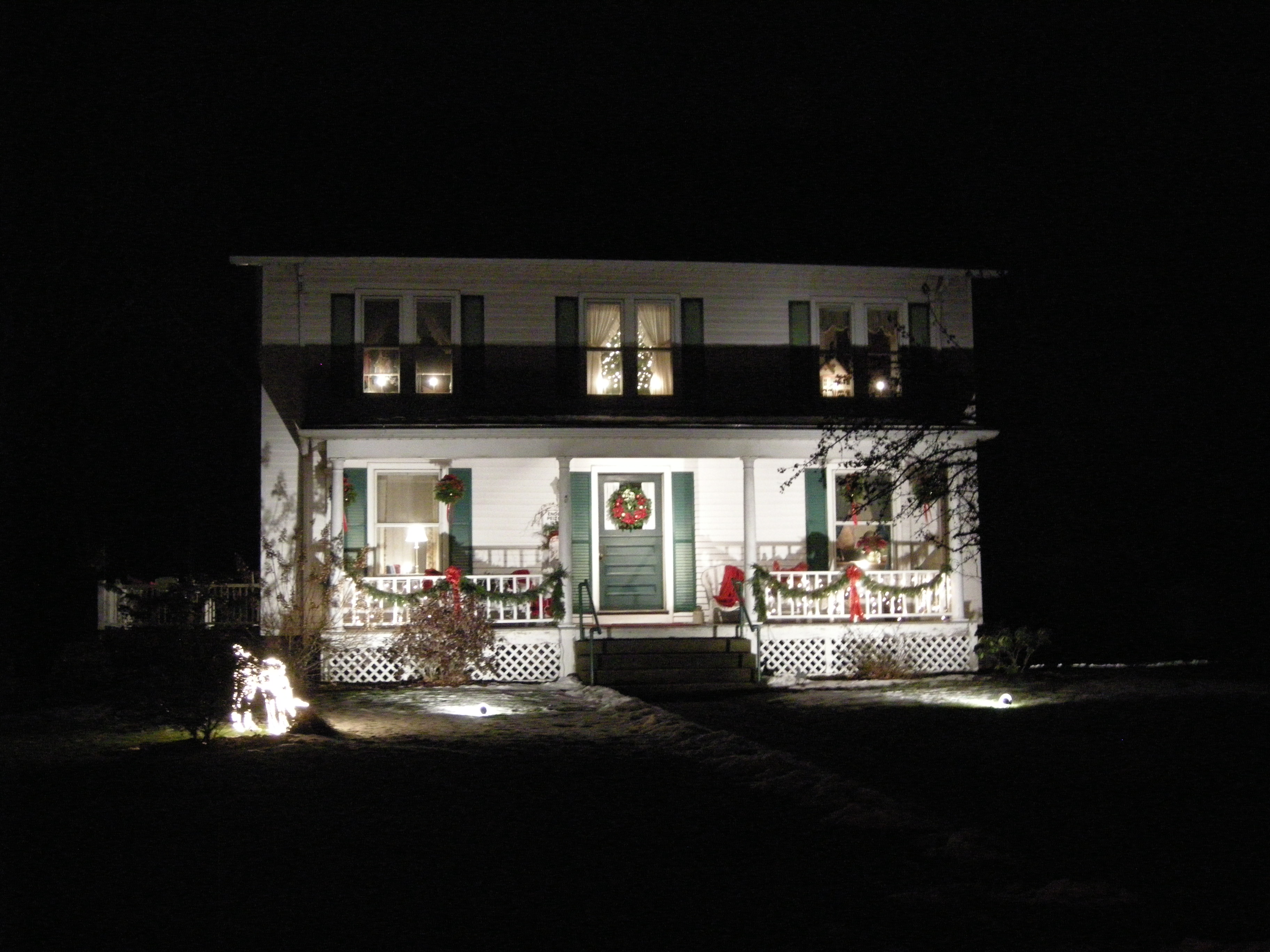
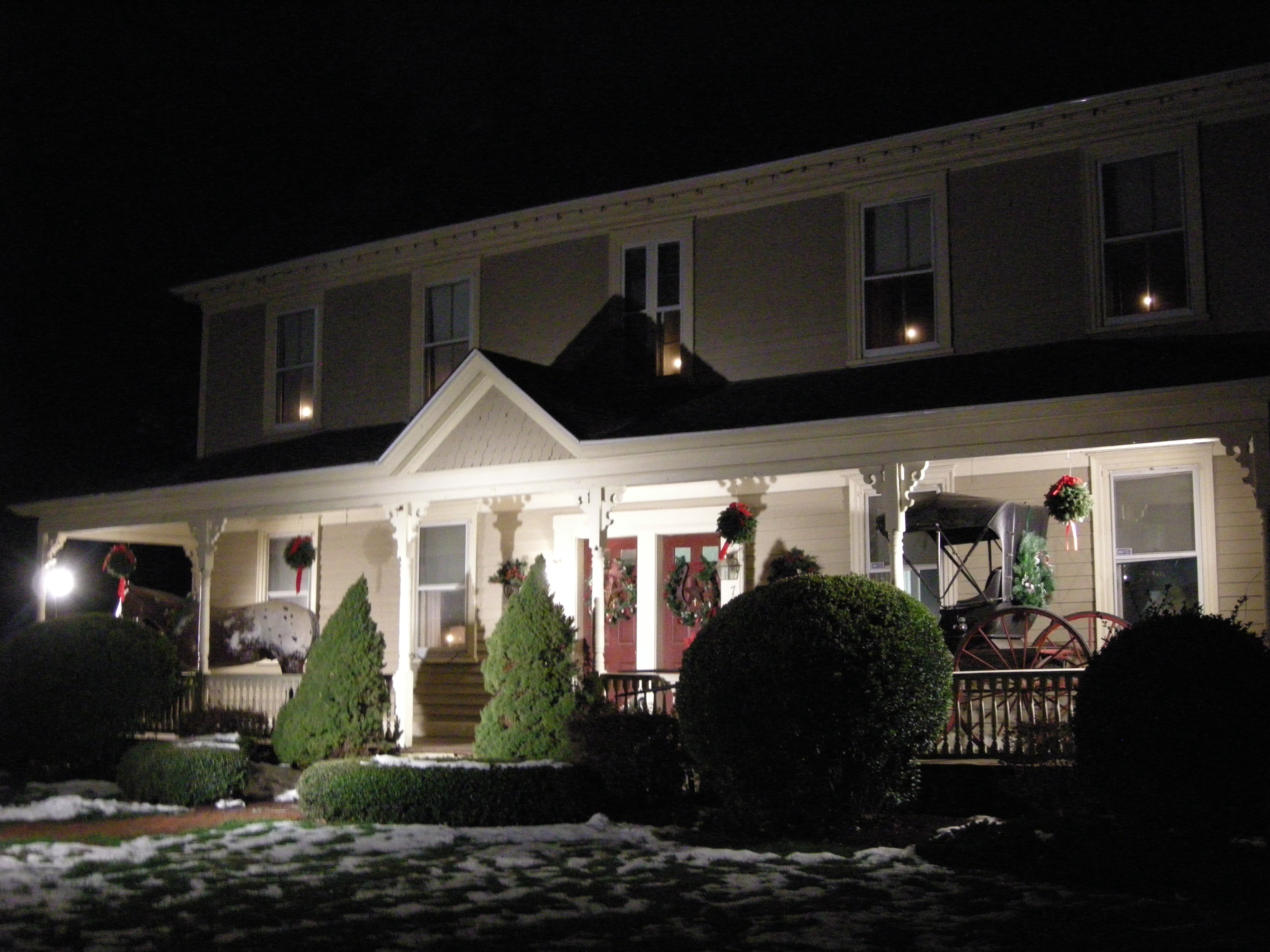
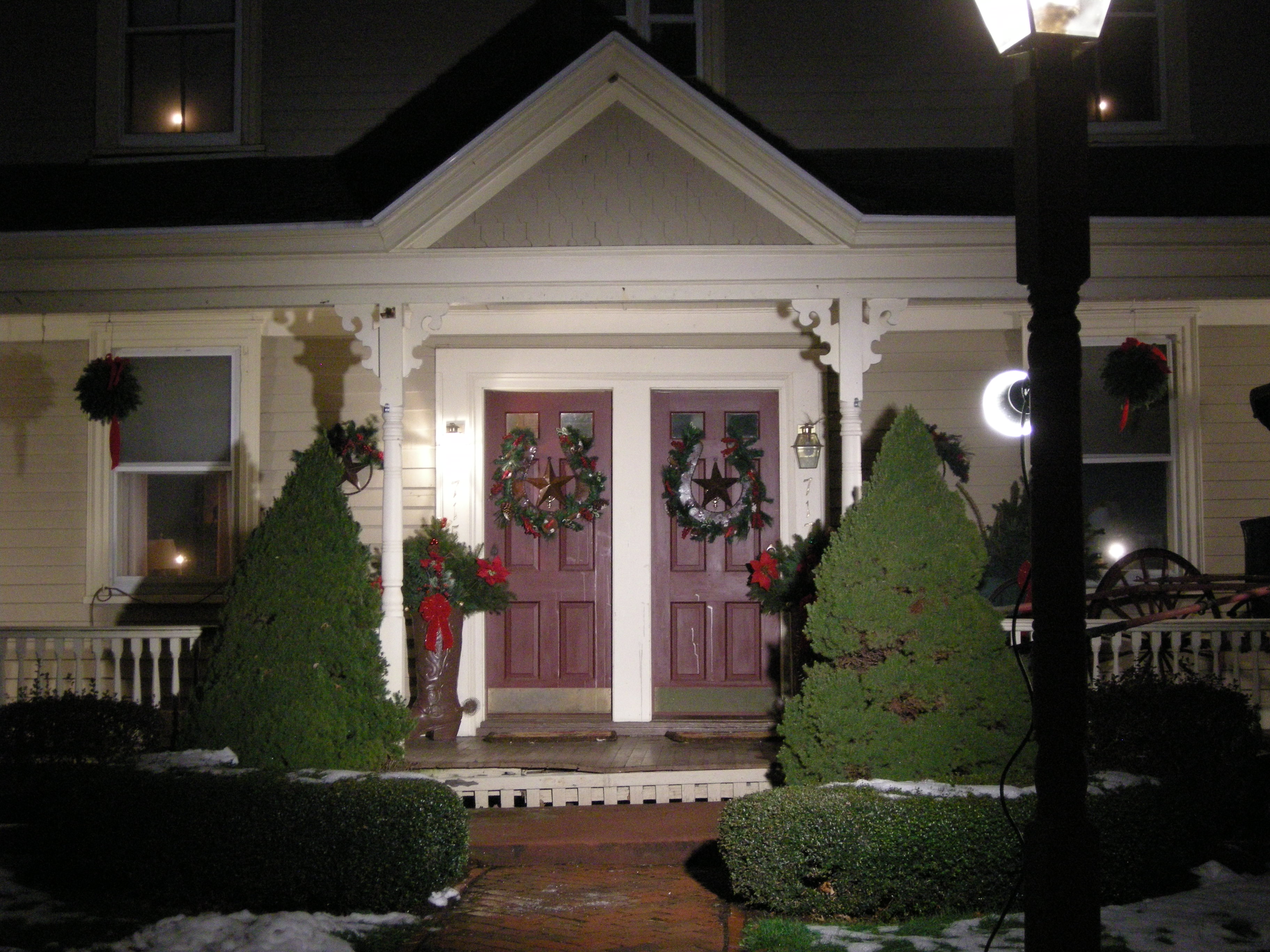
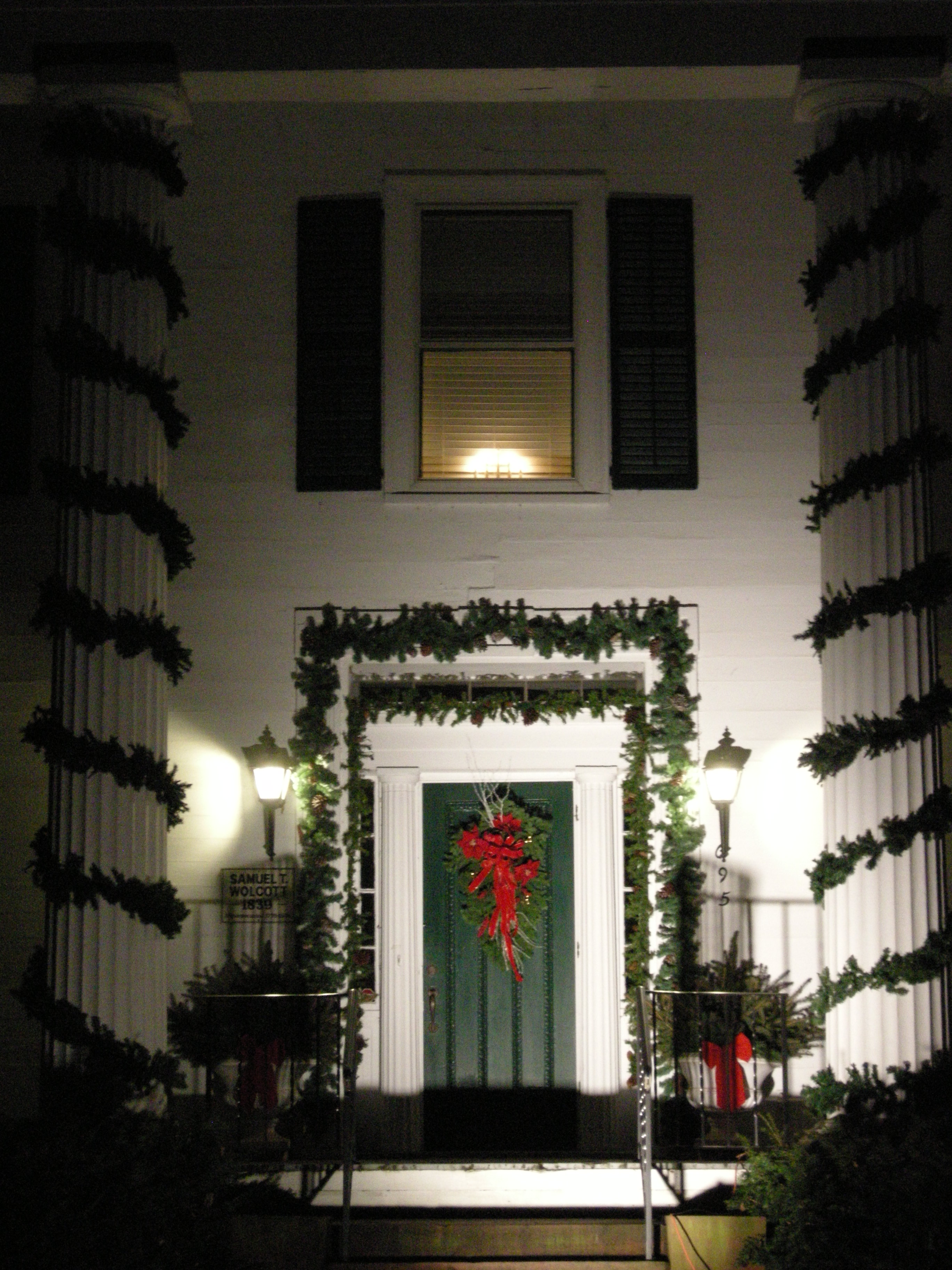
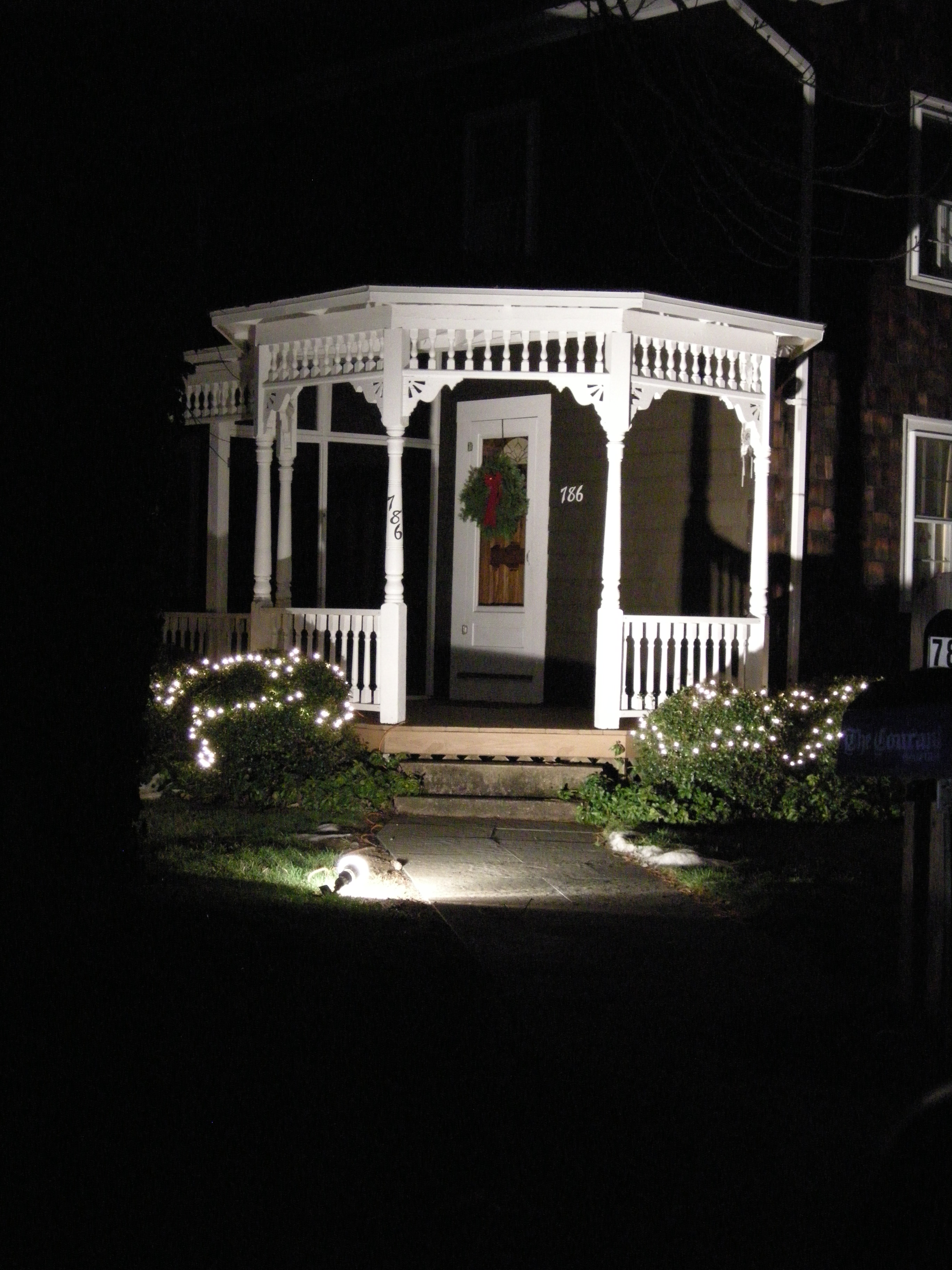
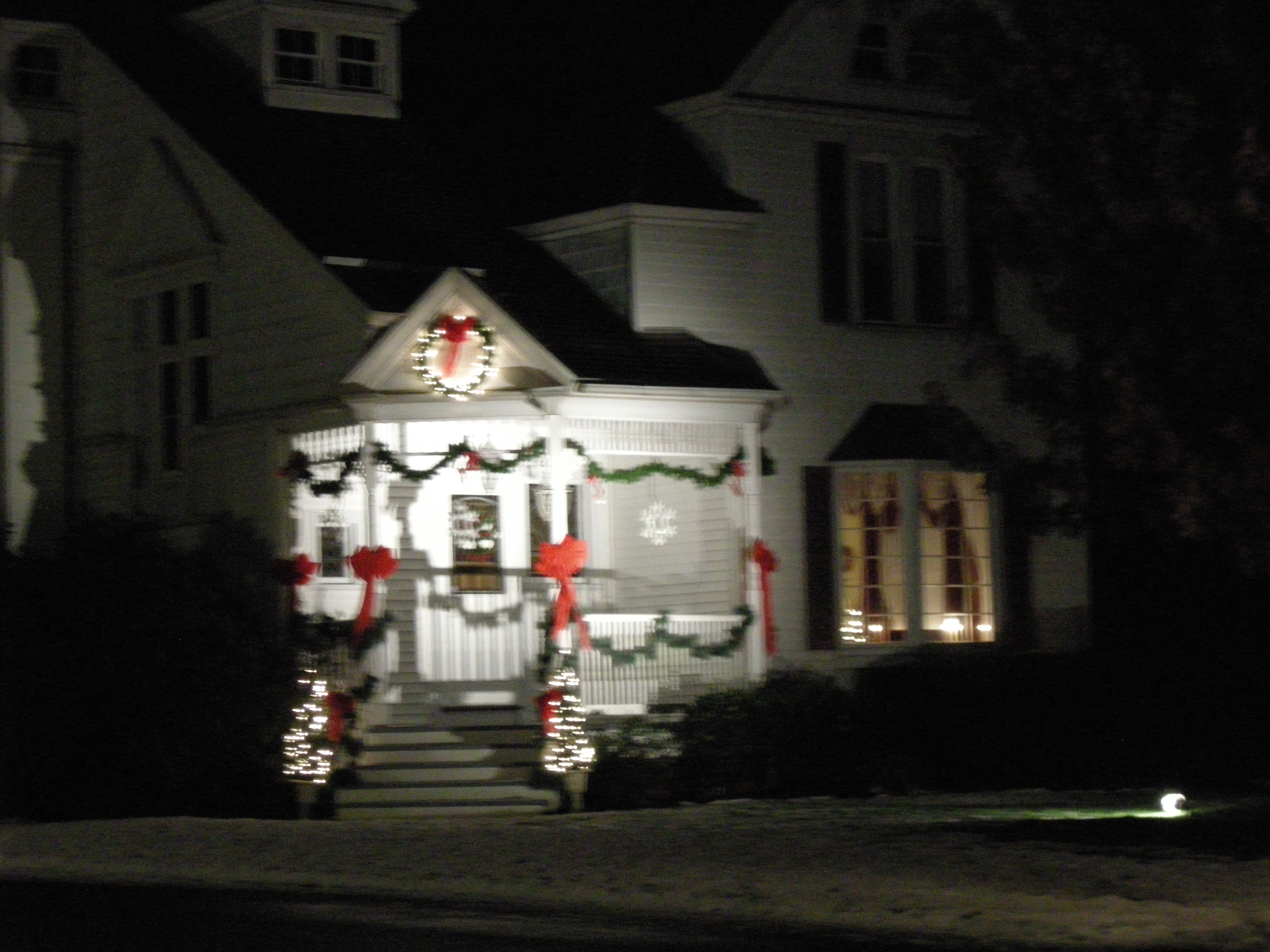
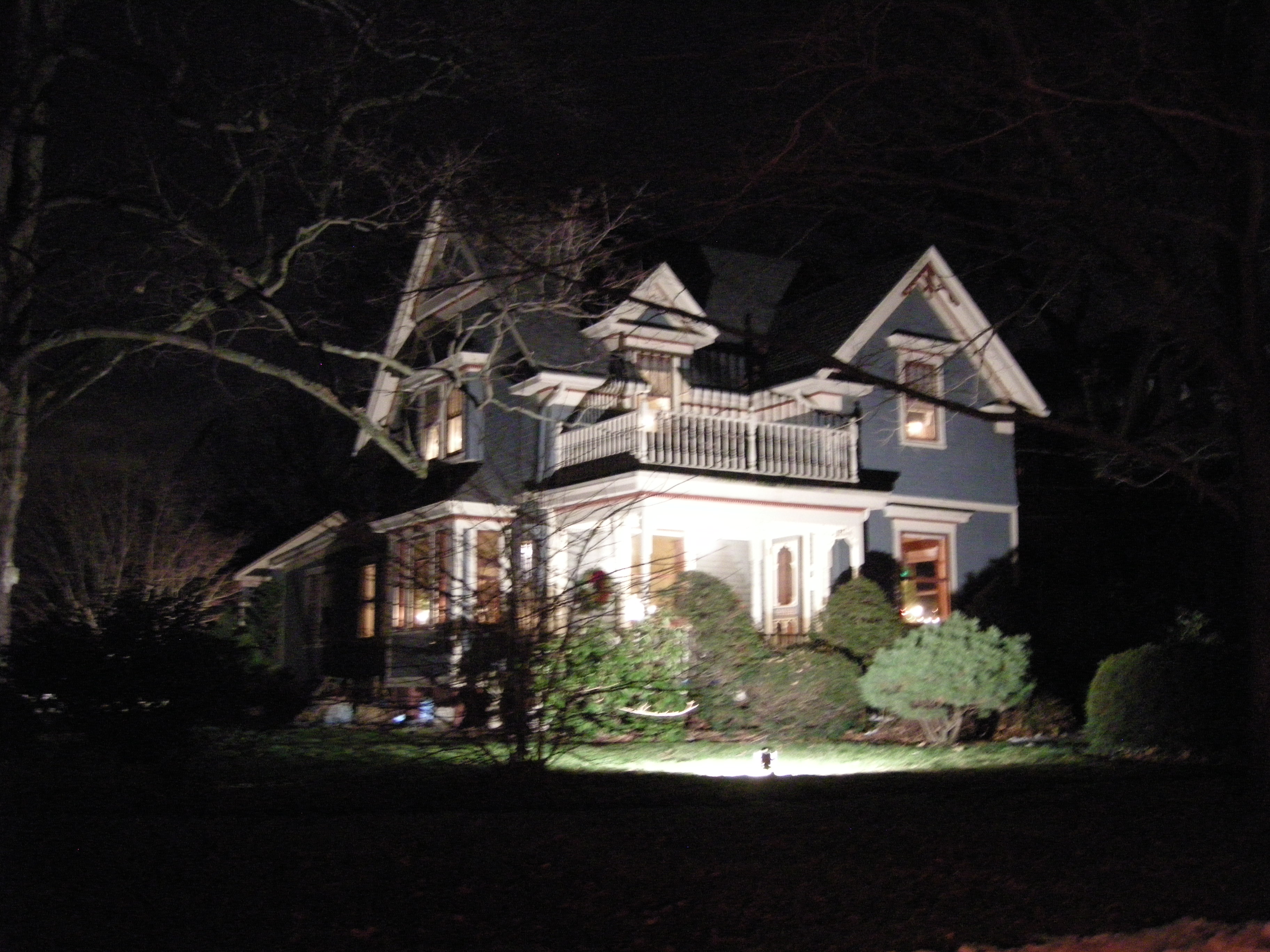
The neighborhood here is rich with history and the architecture that reflects it.  At this time of year, 18th century homes dressed festively with greens, and small paned windows lit with candles, harken us back to a calmer, simpler time when these colonial homes, warmed by fires and friendly spirits, welcomed friend and traveler.

I wanted to share some holiday images, from our neighborhood to yours, and wish you all a Merry Christmas!

to think this house is from Sears!

yes - that's a horse and carriage on the porch!

and horseshoe wreaths and cowboy boot!

Happy Holidays All – and may the New Year hold for you love and peace and endless possibilities!

antique floors

The most extensive amount of woodwork in an original 18th century house lies directly underfoot.  These time worn boards set the tone of every room.  Their mellowed color, ancient widths and rich patina hold history in their very grain.  At first glance we have an intuitive response, and immediate respect, for the hands that shaped them, the years that mellowed them and the history that gave them character.

Original rosehead nails, embedded at the very edges, hold fast to the joists below with a strength forged by a long forgotten blacksmith.  Giant oaks, pitch pines, hemlock and poplar that once stood mighty in the surrounding hills, now lay across miles of New England floors, testaments to the pride and skill of a hardy generation that risked everything to help shape a new world.

Recently, we visited an 18th century home replete with some of the most coveted architectural trim and woodwork of the period.  The tiered brownstone steps led to a main entrance surrounded by a magnificent pedimented doorway.  The four foot wide paneled Dutch door still had its original brass knocker.  The arched fan light above shimmered with wavy glass.  Four fluted columns framed the sidelights between them, and an ornately carved Palladian window towered above it all.

It was hard to get past the front door, with so much to take in.  The outside adornment is usually a pretty good indicator of what lies within.  I could just imagine the trim – paneled staircase, wainscot, moulded cornices and mantels – in their earthen colors, and the flooring, I was certain, would be a glorious pumpkin pine.

The homeowners were excited to share their home.  It was a new acquisition, and they were eager to learn more about the treasures they had.   They wanted to do the right thing – music to our ears.  If only more people would inquire, delve deeper into understanding their old house before taking liberties with it, before changing woodwork, fireplaces, flooring – and even floor plans – on a whim.  Why would anyone buy an old house to gut it?  To change it?  To remove from it all that gave it character and meaning?  That’s a rant for another day.  We were there to consult about several tasks, but most importantly, flooring.

Over the years the boards had shrunk.  In some areas the gaps were as wide as an inch.  In some rooms the boards had been painted, but in most they had just been varnished or covered with shellac.  They wanted to know how to go about refinishing them and what did we think it would cost.  This is the part that is so hard for so many to fathom.   The grunt work, the elbow grease involved in reviving an antique floor.  You cannot bring in the refinishers from your local flooring showroom.  Armed with industrial sanders they can, in one day, or an hour, undo what took three hundred years of time and history to create.

This has to be one of the most heart wrenching scenes – the aftermath of a day of sanding machines gouging across the floors of an antique house.  Three hundred years of original character and patina – lost.

Some people are truly sensitive to preservation.  They appreciate the past and the reasons to preserve it.  Even when they understand that value is maintained by preserving character, integrity, color and finish of original details, sometimes that devil, called convenience and economy, wins in the end.

And that is what would happen here.  We advised, they ignored, and that phenomenal antique house now has a lousy new floor.  The rosehead nails were sunk – a half inch below the surface! – which makes the floor look like it has holes gouged in it everywhere, and instead of a rich antique color to ground and tone the rooms, a light blond finish screams from below.

Henry Francis Dupont, in decorating Winterthur cautioned that, in good design no one thing in a room should stand out.  Newly finished floors stand out.  They overwhelm.  They scream of their loss.  And invariably, the homeowner who has been talked into taking these “convenient” and “economical” measures, regrets it later.

So I urge you, please, to love your old floors, even if they’re covered in stubborn paint or shellac.  Strip them carefully,  by hand, reveal their color, and enjoy their rich history.

creating atmosphere – 18th century style

Our eternal goal, the creative essence of all of our work, our reason for getting up every morning – to recreate the atmosphere of 18th century living.  Insane, I know.  But we all have our quirks!  For some it’s the behavior of red ants, or others the nature of black holes.  Like the needle drawn to magnetic north, we are forever drawn to the domestic architecture of early New England, its history, craftsmanship, in all of its glorious detail.

Room by room, the excitement to fulfill that goal – to add all that it takes to create historic ambiance – has never diminished.  Achieving the proportion and balance – from the correct size bead on a door jamb to the right size bevel of a panel, from the hand planed surface to the marks left by the plane, knowing what to leave and what to leave out, make the difference in achieving the atmosphere of a room.  It’s a life lived in and around 18th century architecture, and having a passion for it, that instills this passion and knowledge.

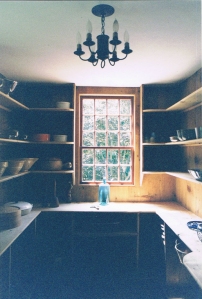
Right now, we are cleaning, prepping and selecting just the right antique boards with just the right marks to put in all the right places to recreate a room we’ll be calling the Buttery.  Old boards skillfully placed horizontally (or vertically) along four walls, shelving milled and fashioned to fit, cabinetry and doors crafted to emulate two hundred year old cupboards, their knobs turned and installed at just the right height.  All will be carefully touched up here and there to cover new milling.  The design on paper is, perhaps, tweaked in the field according to the “feel” of the room, beams across the ceiling, casings at the edges, plaster in the white spaces, antique floors below.  The Buttery will become a space with its own identity, a small cozy nook you won’t want to leave.  Shelves filled with the garden’s bounty, a stone sink to wash the harvest, a window that overlooks the garden, a Dutch door that opens to it, this small space will provide as much for the soul as it will for the table.

Decisions – hundreds of them – go into creating even this tiny space.  From selecting the boards to cleaning and prepping them, deciding their arrangement and use – not all will be usable as they have to match.  You cannot sand them or you’ll lose the patina and the marks.  Yet they have to be milled for use – it must be done carefully with aesthetic decisions made all the way.  Do you keep the knot, which ones?  From species of wood to condition to thickness, some must be planed to match – watch out for nails!  What for counters, what for walls?  Which for the cabinet doors?  Drawers?  Shall we bead the drawer fronts or leave square?  What’s the style of the rest of the room?  What height the counters?  Same all the way around?  Lower under the window?  Can the room hold beams or is the ceiling too tall, or too low?  Oh – there are those awful cans in the ceiling – they have to go!  Shelves at the top?  Or cupboards – how deep?  Oh no – they want space for a microwave?!

Not just anyone can pull all of this together, make it work, or even wants to be bothered.  It’s a laborious task – finding the old wood, selecting, cleaning, prepping, then selecting again for re-use.  Whether working with old or new, it takes an intuitive sense of design, an intimate knowledge of the architecture, and a love for the craftsmanship and detail, to successfully recreate an 18th century space.

So, friends, if you’re wondering why we’re looking a little haggard after all these years – now you know.  Yet, while we may not be granted the years, we certainly harbor the passion, to continue for forty more.  So many homes, so many rooms, so little time!

It’s a welcome challenge, though, capturing time.  Can’t think of a better way to spend it – capturing and recreating for others the atmosphere they long to live in, the incomparable comfort, style and grace of the 18th century.

a sorry sight

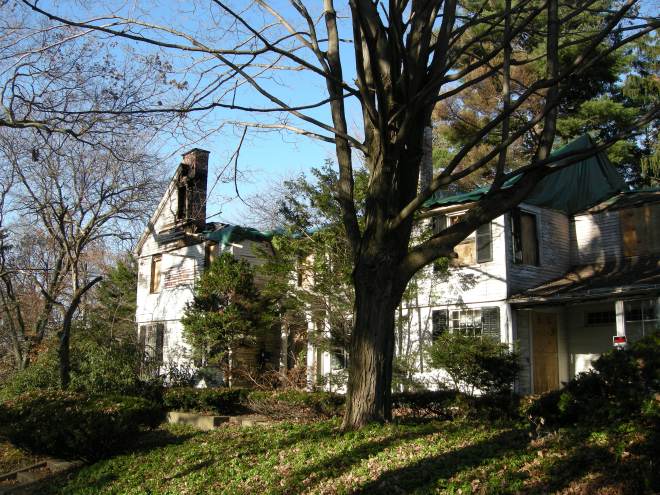
Recently a friend suggested we check out an old house that looked like it had been through a fire.  He didn’t know anything about it, just happened to drive by and thought we’d be interested.

The weekend was sunny and we decided it was perfect for a drive to see an old house, or two, whatever the condition.

We wound our way through a neighborhood of white colonials, mature trees and perfect landscaping.  The lawns were still a lush green, with just enough leaves sprinkled about to remind us it’s Fall.  Every home design was well thought out, from the three story with dentil moulding at the eaves to the tiny gambrel with weathered shingles and red painted door.  Some sat high on a knoll, others hugged the ground low.  Their placement among their neighbors was perfect.  The whole scene was the stuff of calendars.

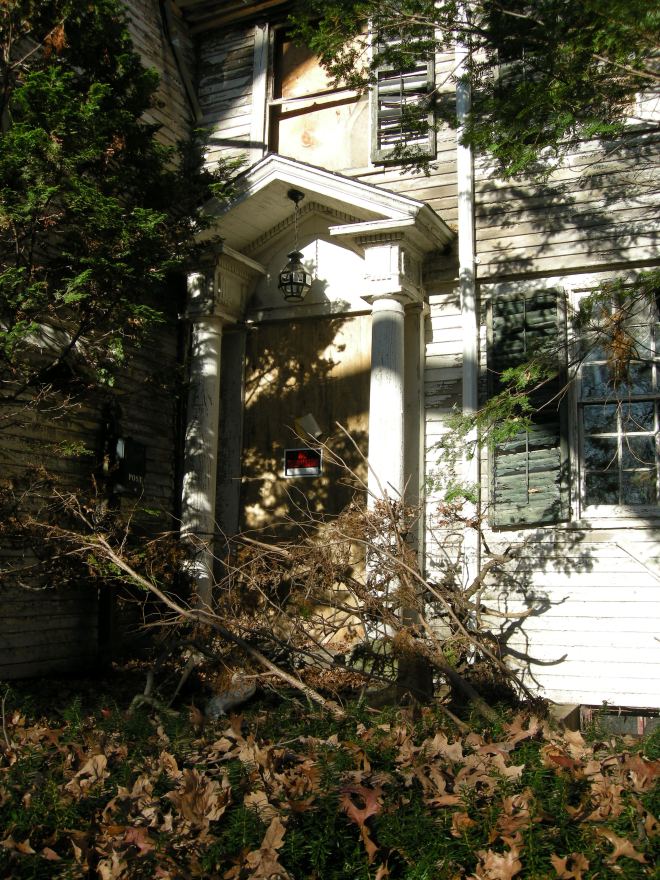
Then we came to it.  It sat high and prominent, impossible to hide its sorry state.  We drove up the driveway to park and take a look around.  No trespassing signs were everywhere, but those are for the bad guys.

DSCN3952

We were there to help.  I took some photos while my husband left his card in the door and circled the house to investigate its details.

The driveway abutted a neighbor’s back yard and she was rather annoyed that we’d ignored the signs.  My husband assured her we were good guys, we try to save houses like this.

She said yes, obviously, there had been a fire, but the owners had no insurance.

Yikes.

DSCN3961

The rafters are gone, and I can only imagine the water damage inside.  So often as much damage is done putting it out as from the fire itself.

DSCN3960

Will they tear it down, or repair?  Or will it sit, like some, for years?  I’ll keep you posted.


colonial kitchens

The most important room in a house, is arguably, the kitchen.  Not only to satisfy the building inspector who won’t let us live without one anymore, but to satisfy our own creative appetites.  We want them to be special, ample, with lots of storage and modern conveniences.  Because we love the old, we want them to be traditional and charming, as personal and unique as we are.  The trick today is to incorporate all of the new conventions into the old house.  The early builder could never have foreseen the evolution of the modern appliance!  The ten foot wide hearth, with its iron pots and utensils, and large brick bake oven, was more than ample for the early homeowner’s needs.

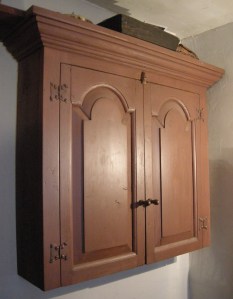
Needless to say, the huge old hearth is not for cooking anymore.   We’ve long since forgotten how to cook over the open fire, or how long to keep an arm in the oven to gauge temperature.  We use electricity or gas rather than wood for cooking, and dials rather than arms for setting temperatures.  While they used open shelving, and an occasional cupboard for storage, today we crave lots of cabinetry to house all of our “stuff.”  blueCab
We want a designated cabinet to house the mixer, or an “appliance lift” to make it easy on our backs; a space to hide the coffee maker, or the microwave, behind a custom retractable door; a slide out trash compartment, with bins for separating trash and recyclables; a tray cabinet beside the stove; a drawer with compartments for cutlery and knives; a drawer for spices; shelves that glide out of the cabinet for easy access to pots and pans;  “lazy susans” to take up that wasted space that occurs in corners where two cabinets meet.  Added to all of this is a stove – often in two parts, or three – a cooktop and one or two separate ovens; a refrigerator which is often way too deep; a dishwasher, and sundry other appliances.  All are usually in stainless steel, and all combine to create an enormous challenge in trying to capture the atmosphere of 18th century living!
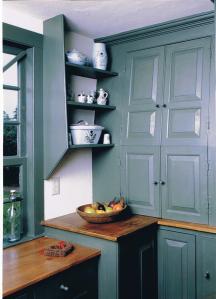
kitchens_display

That old hearth is a place for reflection now, a place to consider how far we’ve come and how far we want to go.  The new kitchen can be incorporated subtly into the old keeping room, or preferably, in a wing off the house entirely.  It can be designed using all of the same ingredients of the old house –wood floors, perhaps beamed ceilings, crown mouldings, raised panel doors, iron hardware.  Putting them tastefully together, thinking like the early craftsman, copying his craftsmanship, even using some of his tools, helps us to achieve the look that works seamlessly with the original house.

new old Buttery The end result should be a room that will feel, when you walk into it, like a logical continuation of the old, or at the very least, part of the natural evolution of the earlier house.
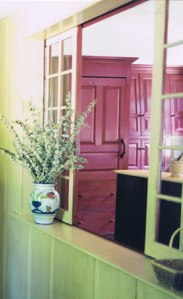
Henry Francis Dupont said of his design at Winterthur, that no one thing should stand out when you enter a room, essentially, everything should carry its own weight.  That is true about kitchens as well – so good luck with the refrigerator!  And the stove, and the ovens!  Well, we’ve dealt with these for many years.  While they are challenging, they are not impossible.  It is never a perfect solution, but a pretty good one.  We do live in the 21st century after all, another evolution in design, which is not always kind to the 18th century.  We certainly don’t want to use chrome and glass or melamine and formica.  Well, we don’t want a lot of things.

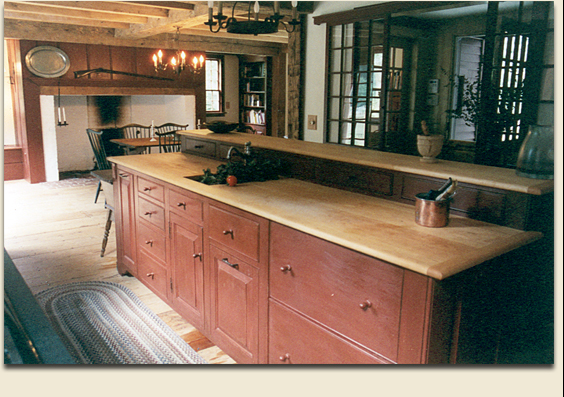
litner_kitchen2 But what we do want are classical designs using the same elements that attracted us to the house in the first place.  The natural elements that keep us grounded, that remind us we are of the earth and want to remain in touch with it.
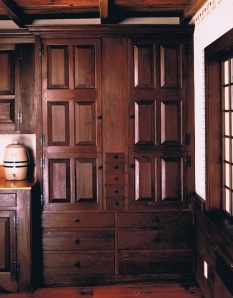
Clay, wood, plaster, stone, glass, and a few variations on those themes, as close to what is found in original colonial homes, will keep any new room in tune with the old.  Wood cabinets, plaster walls, brick or stone fireplaces and hearths, material selection is of utmost importance, as is the proportion and balance of design.  (I overuse that term, but it is everything!)  We are in a constant struggle between fitting in what the customer wants and what the house will not be overwhelmed by.  We don’t want to walk into the kitchen and have it scream at us –“I am a kitchen, and the most important room in your house!”

Shaker style kitchen cabinetry It should be a pleasant, useful space, whose cabinetry and woodwork do not overwhelm with over-design.  It is easy for a homeowner to be seduced by the array of cabinetry and gadgets on display in a kitchen showroom.  From the simpler Shaker style to European extravagance, a homeowner can be overwhelmed and end up “picking” a style they like right there on the floor, rather than one that works seamlessly within the context of their own home.

We purchase a home because we love its style, and recognize its possibilities.  That’s important to remember, and stick to, when choosing a kitchen design.  Custom design is worth it, to know that the cabinetry will be designed specifically for our working space needs, and fit seamlessly into our style of home.  Nothing will stand out.  The cabinetry and woodwork will feel like it was always there, contributing to, rather than distracting from, the charm of the colonial home.