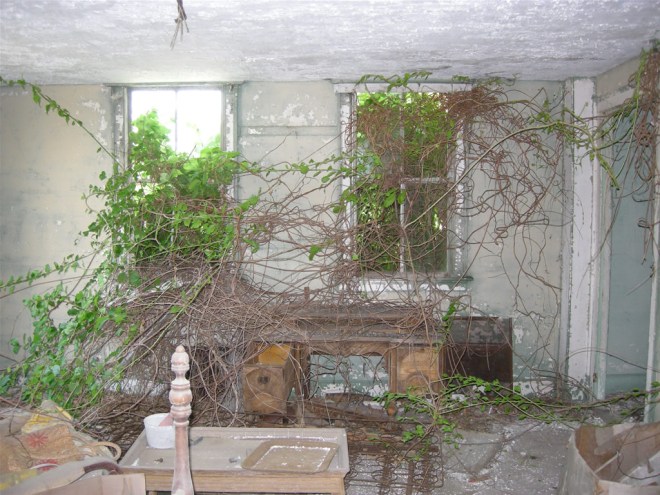
antique floors

The most extensive amount of woodwork in an original 18th century house lies directly underfoot.  These time worn boards set the tone of every room.  Their mellowed color, ancient widths and rich patina hold history in their very grain.  At first glance we have an intuitive response, and immediate respect, for the hands that shaped them, the years that mellowed them and the history that gave them character.

Original rosehead nails, embedded at the very edges, hold fast to the joists below with a strength forged by a long forgotten blacksmith.  Giant oaks, pitch pines, hemlock and poplar that once stood mighty in the surrounding hills, now lay across miles of New England floors, testaments to the pride and skill of a hardy generation that risked everything to help shape a new world.

Recently, we visited an 18th century home replete with some of the most coveted architectural trim and woodwork of the period.  The tiered brownstone steps led to a main entrance surrounded by a magnificent pedimented doorway.  The four foot wide paneled Dutch door still had its original brass knocker.  The arched fan light above shimmered with wavy glass.  Four fluted columns framed the sidelights between them, and an ornately carved Palladian window towered above it all.

It was hard to get past the front door, with so much to take in.  The outside adornment is usually a pretty good indicator of what lies within.  I could just imagine the trim – paneled staircase, wainscot, moulded cornices and mantels – in their earthen colors, and the flooring, I was certain, would be a glorious pumpkin pine.

The homeowners were excited to share their home.  It was a new acquisition, and they were eager to learn more about the treasures they had.   They wanted to do the right thing – music to our ears.  If only more people would inquire, delve deeper into understanding their old house before taking liberties with it, before changing woodwork, fireplaces, flooring – and even floor plans – on a whim.  Why would anyone buy an old house to gut it?  To change it?  To remove from it all that gave it character and meaning?  That’s a rant for another day.  We were there to consult about several tasks, but most importantly, flooring.

Over the years the boards had shrunk.  In some areas the gaps were as wide as an inch.  In some rooms the boards had been painted, but in most they had just been varnished or covered with shellac.  They wanted to know how to go about refinishing them and what did we think it would cost.  This is the part that is so hard for so many to fathom.   The grunt work, the elbow grease involved in reviving an antique floor.  You cannot bring in the refinishers from your local flooring showroom.  Armed with industrial sanders they can, in one day, or an hour, undo what took three hundred years of time and history to create.

This has to be one of the most heart wrenching scenes – the aftermath of a day of sanding machines gouging across the floors of an antique house.  Three hundred years of original character and patina – lost.

Some people are truly sensitive to preservation.  They appreciate the past and the reasons to preserve it.  Even when they understand that value is maintained by preserving character, integrity, color and finish of original details, sometimes that devil, called convenience and economy, wins in the end.

And that is what would happen here.  We advised, they ignored, and that phenomenal antique house now has a lousy new floor.  The rosehead nails were sunk – a half inch below the surface! – which makes the floor look like it has holes gouged in it everywhere, and instead of a rich antique color to ground and tone the rooms, a light blond finish screams from below.

Henry Francis Dupont, in decorating Winterthur cautioned that, in good design no one thing in a room should stand out.  Newly finished floors stand out.  They overwhelm.  They scream of their loss.  And invariably, the homeowner who has been talked into taking these “convenient” and “economical” measures, regrets it later.

So I urge you, please, to love your old floors, even if they’re covered in stubborn paint or shellac.  Strip them carefully,  by hand, reveal their color, and enjoy their rich history.

creating atmosphere – 18th century style

Our eternal goal, the creative essence of all of our work, our reason for getting up every morning – to recreate the atmosphere of 18th century living.  Insane, I know.  But we all have our quirks!  For some it’s the behavior of red ants, or others the nature of black holes.  Like the needle drawn to magnetic north, we are forever drawn to the domestic architecture of early New England, its history, craftsmanship, in all of its glorious detail.

Room by room, the excitement to fulfill that goal – to add all that it takes to create historic ambiance – has never diminished.  Achieving the proportion and balance – from the correct size bead on a door jamb to the right size bevel of a panel, from the hand planed surface to the marks left by the plane, knowing what to leave and what to leave out, make the difference in achieving the atmosphere of a room.  It’s a life lived in and around 18th century architecture, and having a passion for it, that instills this passion and knowledge.

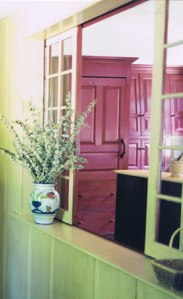
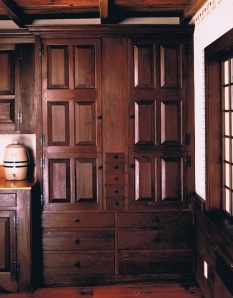
Right now, we are cleaning, prepping and selecting just the right antique boards with just the right marks to put in all the right places to recreate a room we’ll be calling the Buttery.  Old boards skillfully placed horizontally (or vertically) along four walls, shelving milled and fashioned to fit, cabinetry and doors crafted to emulate two hundred year old cupboards, their knobs turned and installed at just the right height.  All will be carefully touched up here and there to cover new milling.  The design on paper is, perhaps, tweaked in the field according to the “feel” of the room, beams across the ceiling, casings at the edges, plaster in the white spaces, antique floors below.  The Buttery will become a space with its own identity, a small cozy nook you won’t want to leave.  Shelves filled with the garden’s bounty, a stone sink to wash the harvest, a window that overlooks the garden, a Dutch door that opens to it, this small space will provide as much for the soul as it will for the table.

Decisions – hundreds of them – go into creating even this tiny space.  From selecting the boards to cleaning and prepping them, deciding their arrangement and use – not all will be usable as they have to match.  You cannot sand them or you’ll lose the patina and the marks.  Yet they have to be milled for use – it must be done carefully with aesthetic decisions made all the way.  Do you keep the knot, which ones?  From species of wood to condition to thickness, some must be planed to match – watch out for nails!  What for counters, what for walls?  Which for the cabinet doors?  Drawers?  Shall we bead the drawer fronts or leave square?  What’s the style of the rest of the room?  What height the counters?  Same all the way around?  Lower under the window?  Can the room hold beams or is the ceiling too tall, or too low?  Oh – there are those awful cans in the ceiling – they have to go!  Shelves at the top?  Or cupboards – how deep?  Oh no – they want space for a microwave?!

Not just anyone can pull all of this together, make it work, or even wants to be bothered.  It’s a laborious task – finding the old wood, selecting, cleaning, prepping, then selecting again for re-use.  Whether working with old or new, it takes an intuitive sense of design, an intimate knowledge of the architecture, and a love for the craftsmanship and detail, to successfully recreate an 18th century space.

So, friends, if you’re wondering why we’re looking a little haggard after all these years – now you know.  Yet, while we may not be granted the years, we certainly harbor the passion, to continue for forty more.  So many homes, so many rooms, so little time!

It’s a welcome challenge, though, capturing time.  Can’t think of a better way to spend it – capturing and recreating for others the atmosphere they long to live in, the incomparable comfort, style and grace of the 18th century.

a sorry sight

Recently a friend suggested we check out an old house that looked like it had been through a fire.  He didn’t know anything about it, just happened to drive by and thought we’d be interested.

The weekend was sunny and we decided it was perfect for a drive to see an old house, or two, whatever the condition.

We wound our way through a neighborhood of white colonials, mature trees and perfect landscaping.  The lawns were still a lush green, with just enough leaves sprinkled about to remind us it’s Fall.  Every home design was well thought out, from the three story with dentil moulding at the eaves to the tiny gambrel with weathered shingles and red painted door.  Some sat high on a knoll, others hugged the ground low.  Their placement among their neighbors was perfect.  The whole scene was the stuff of calendars.

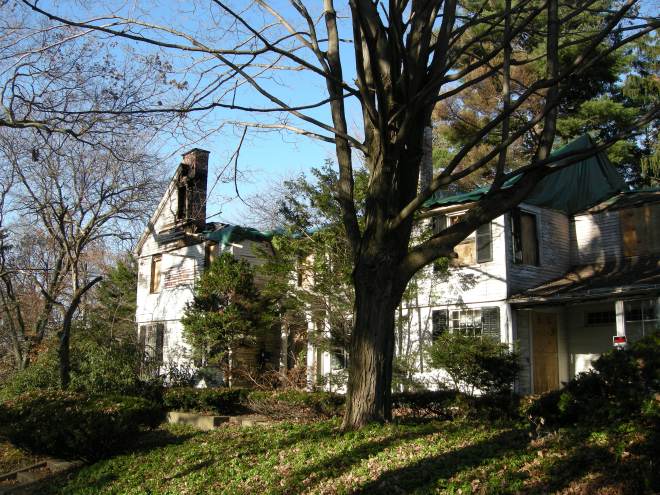
Then we came to it.  It sat high and prominent, impossible to hide its sorry state.  We drove up the driveway to park and take a look around.  No trespassing signs were everywhere, but those are for the bad guys.

DSCN3952

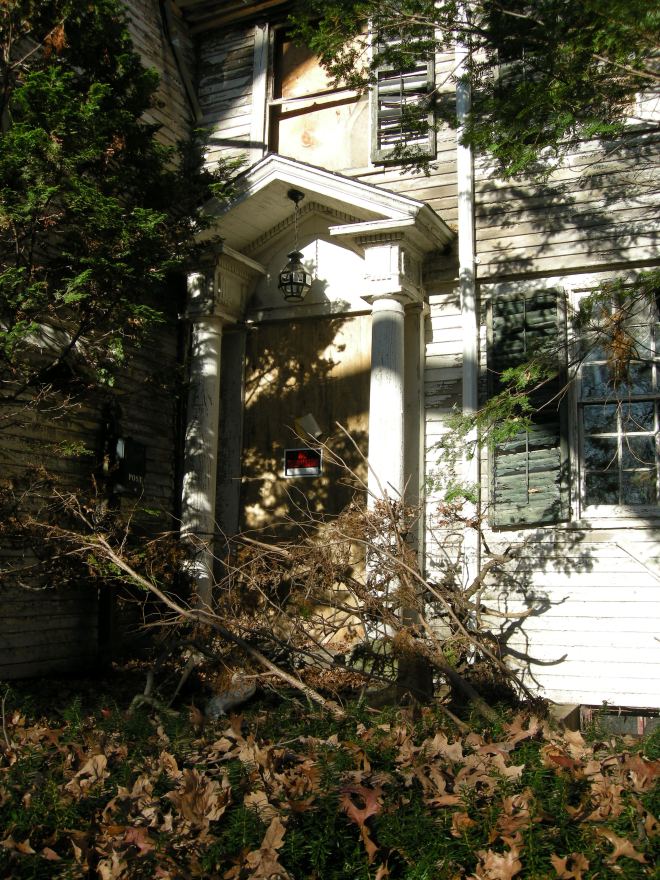
We were there to help.  I took some photos while my husband left his card in the door and circled the house to investigate its details.

The driveway abutted a neighbor’s back yard and she was rather annoyed that we’d ignored the signs.  My husband assured her we were good guys, we try to save houses like this.

She said yes, obviously, there had been a fire, but the owners had no insurance.

Yikes.

DSCN3961

The rafters are gone, and I can only imagine the water damage inside.  So often as much damage is done putting it out as from the fire itself.

DSCN3960

Will they tear it down, or repair?  Or will it sit, like some, for years?  I’ll keep you posted.


colonial kitchens

The most important room in a house, is arguably, the kitchen.  Not only to satisfy the building inspector who won’t let us live without one anymore, but to satisfy our own creative appetites.  We want them to be special, ample, with lots of storage and modern conveniences.  Because we love the old, we want them to be traditional and charming, as personal and unique as we are.  The trick today is to incorporate all of the new conventions into the old house.  The early builder could never have foreseen the evolution of the modern appliance!  The ten foot wide hearth, with its iron pots and utensils, and large brick bake oven, was more than ample for the early homeowner’s needs.

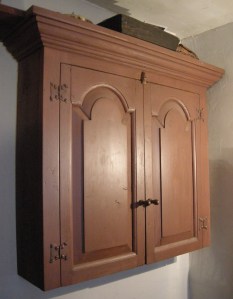
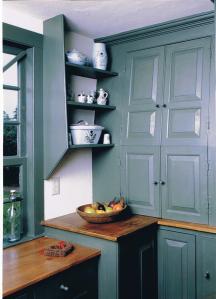
Needless to say, the huge old hearth is not for cooking anymore.   We’ve long since forgotten how to cook over the open fire, or how long to keep an arm in the oven to gauge temperature.  We use electricity or gas rather than wood for cooking, and dials rather than arms for setting temperatures.  While they used open shelving, and an occasional cupboard for storage, today we crave lots of cabinetry to house all of our “stuff.”  blueCab

We want a designated cabinet to house the mixer, or an “appliance lift” to make it easy on our backs; a space to hide the coffee maker, or the microwave, behind a custom retractable door; a slide out trash compartment, with bins for separating trash and recyclables; a tray cabinet beside the stove; a drawer with compartments for cutlery and knives; a drawer for spices; shelves that glide out of the cabinet for easy access to pots and pans;  “lazy susans” to take up that wasted space that occurs in corners where two cabinets meet.  Added to all of this is a stove – often in two parts, or three – a cooktop and one or two separate ovens; a refrigerator which is often way too deep; a dishwasher, and sundry other appliances.  All are usually in stainless steel, and all combine to create an enormous challenge in trying to capture the atmosphere of 18th century living!

kitchens_display

That old hearth is a place for reflection now, a place to consider how far we’ve come and how far we want to go.  The new kitchen can be incorporated subtly into the old keeping room, or preferably, in a wing off the house entirely.  It can be designed using all of the same ingredients of the old house –wood floors, perhaps beamed ceilings, crown mouldings, raised panel doors, iron hardware.  Putting them tastefully together, thinking like the early craftsman, copying his craftsmanship, even using some of his tools, helps us to achieve the look that works seamlessly with the original house.

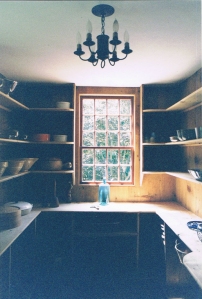
new old Buttery The end result should be a room that will feel, when you walk into it, like a logical continuation of the old, or at the very least, part of the natural evolution of the earlier house.

Henry Francis Dupont said of his design at Winterthur, that no one thing should stand out when you enter a room, essentially, everything should carry its own weight.  That is true about kitchens as well – so good luck with the refrigerator!  And the stove, and the ovens!  Well, we’ve dealt with these for many years.  While they are challenging, they are not impossible.  It is never a perfect solution, but a pretty good one.  We do live in the 21st century after all, another evolution in design, which is not always kind to the 18th century.  We certainly don’t want to use chrome and glass or melamine and formica.  Well, we don’t want a lot of things.

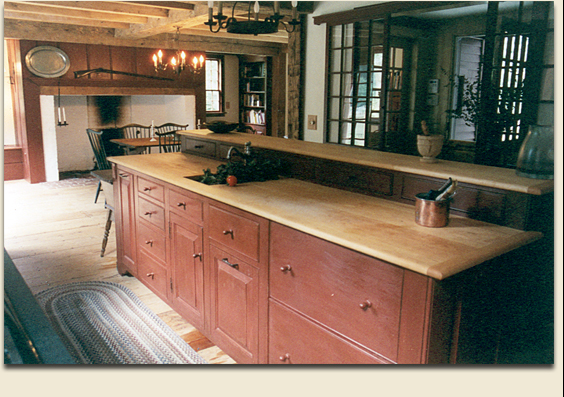
litner_kitchen2 But what we do want are classical designs using the same elements that attracted us to the house in the first place.  The natural elements that keep us grounded, that remind us we are of the earth and want to remain in touch with it.

Clay, wood, plaster, stone, glass, and a few variations on those themes, as close to what is found in original colonial homes, will keep any new room in tune with the old.  Wood cabinets, plaster walls, brick or stone fireplaces and hearths, material selection is of utmost importance, as is the proportion and balance of design.  (I overuse that term, but it is everything!)  We are in a constant struggle between fitting in what the customer wants and what the house will not be overwhelmed by.  We don’t want to walk into the kitchen and have it scream at us –“I am a kitchen, and the most important room in your house!”

Shaker style kitchen cabinetry It should be a pleasant, useful space, whose cabinetry and woodwork do not overwhelm with over-design.  It is easy for a homeowner to be seduced by the array of cabinetry and gadgets on display in a kitchen showroom.  From the simpler Shaker style to European extravagance, a homeowner can be overwhelmed and end up “picking” a style they like right there on the floor, rather than one that works seamlessly within the context of their own home.

We purchase a home because we love its style, and recognize its possibilities.  That’s important to remember, and stick to, when choosing a kitchen design.  Custom design is worth it, to know that the cabinetry will be designed specifically for our working space needs, and fit seamlessly into our style of home.  Nothing will stand out.  The cabinetry and woodwork will feel like it was always there, contributing to, rather than distracting from, the charm of the colonial home.

old houses

Our own interest began a lifetime ago, and our passion for the endless merits of 18th century design has grown exponentially in the past forty years.  Living in, restoring and reproducing the various facets of colonial architecture has served to increase our awe over what these craftsmen were able to accomplish  with so little.  Craftsmen who, armed with apprenticeships and a few tools, carved elaborate doorways, decorative cornices, and intricate fireplace surrounds.  From felling the trees to hand scraping a finish flute, their determination and their skill was boundless.  Guided by architects such as Bulfinch, Benjamin and Latrobe, 18th and 19th century American architecture was shaped by the capable hands of men who had a reverence for their medium and a pride in their craft.

Our passion and our pride have been to emulate these extraordinary men and to promote the growth of the architecture they began.  Toward this end, we turned our own hearts and hands to the design and construction of period authentic 18th century architecture while still in college in the late 1960’s.  After several restorations, in 1973, we purchased what would become our own home, a derelict 17th century house that needed work from the ground up.  Early dreams of a life in art and music were over, and it was time to earn a living in the “real” world.  Armed with a tag sale table saw and a pen knife, in the front room of our old house, we set up a work bench, strapped on a tool belt, and laid out an old four panel door across a pair of saw horses.

latLike doctors performing an autopsy, we carefully deconstructed it to see how it was put together.  Gently, we knocked out the pins, gingerly tugged at the stiles and rails, slipped the raised panels from their sockets, and studied all of the individual parts.  The tenons, the beveled edges of the panels, their sizes, shapes and thickness, the tiny pins, hand carved to be almost square pegs to fit securely into round holes, were all exposed again for the first time in two hundred years.  We inspected the pieces with a quiet respect, felt the hand of their maker on the planed surface, noted the secrets of their edges.   While we felt a certain irreverence for undoing the past, we sensed a silent approval for the mission on which we were about to embark.

Not only had we figured out how to reproduce that door, but we were so moved and exhilarated by the process, we felt that anything was possible.  If we could reproduce a door, we could build paneling.  If we could build paneling, we could build a cupboard.  If we could build a cupboard, we could build a kitchen!  But wait!  Old houses didn’t have kitchens, per se.  We would have to design something that could fit seamlessly into the atmosphere of an old house and not look new.  Those years of art training and music composition were the perfect background for composing the elements of 18th century architecture into working kitchens and bathrooms and additions and libraries that were desperately needed for modern living.  Goethe said, “Architecture is frozen music.”  It would become our lifelong passion to make every room, every kitchen, every “new” old house be just that.

New London, CT

There is something about whaling cities.  I grew up in one in Massachusetts.  The sound of the gulls in the early morning as they follow the fisherman into port with his catch, the crisp salt air, cool mist and fog that greets the early riser on his morning walk, before being burned off by the rising sun.  The docks lined with fishing fleets that still embark on distant journeys, carrying on a tradition that no longer includes, thankfully, the “harvesting” of whales.  Wind vanes, the landlubbers compass, shaped like whales, ships and seabirds, direct us from rooftops along cobblestone streets.  Widow’s walks are everywhere atop four square colonials, where we romanticize about the wives and lovers who wept and awaited their sailor’s return.

Everywhere the architecture reminds us of a hard won treasure. Blubber, whale oil and bone were transformed by savvy merchants into marble mansions, grand colonials and bigger, sturdier ships with colorful carved figureheads to guard their way.  The affluence that this now distasteful endeavor created, was immense.  Subject to no taxes, these men were able to build grand houses, cities and towns with their fortunes.  Thank goodness.  Our cities are the better for them.  While we may not have approved of their means, we certainly appreciate their gifts.

If only we could have stopped there.  If only the next generations of rich folk hadn’t felt the need to build grander monuments, skyscrapers of concrete and glass, where they could stand in the clouds to survey their minions.

Of course, I am just a common man, but all the common folk I know are much more comfortable at ground level, with materials they understand, bricks and mortar, posts and clapboards, where they can look into the windows of a shop to select a pastry, or step through a door at street level to greet their friend, postman, or merchant.  This was a time when architecture was on a human scale, user friendly.  If a board cracked, anyone could repair it.  If a glass broke, it was easily replaced.  No one I know knows how to fix a skyscraper.

But I’m off on a tangent again, when I really wanted to tell you more about New London and some fascinating places to visit there.  You can walk down the city streets and read its stories through the architecture.  17th, 18th and 19th centuries are well represented.  So much has changed, but with a keen eye, you can see it, a history that is plain and plentiful along the sidewalks of Bank Street, Thames, and Main, Starr Street and Whaler’s Row.  Gables, porticos, colonnades, distinguishable artifacts of another era.  No matter how many times you visit, there will be more to see and much to learn.

On a recent visit, we wanted to see the Hempsted house again, but it was closed.  So we tried the Shaw Mansion, which houses the New London Historical Society – but that was closed.  Determined to explore New London history, we drove down Bank Street and found something open – the Customs House.

NewLondonEtc10-09 018

But first, back to the Hempstead house – a wonderful restoration which every old house lover should visit when it opens again in the summer.  We happened upon it years ago when we’d begun researching for the restoration of our own 17th century house in the early 1970’s.  I remember our surprise at happening upon such an ancient place in what seemed the most unlikely neighborhood.  The corner of Jay and Hempstead Streets, smack in the middle of a city neighborhood, across the street from a school, sat Joshua Hempsted’s 1678 house.  Apparently, it had once enjoyed water views over Bream’s Cove, but that had since been filled in and it now overlooked city streets and houses, very unlike its own.

It was open to the public, and had undergone recent restoration.  I remember a lovely lady of slight frame, silver hair and striking blue eyes, welcoming us at the front door.  It was one of the most ancient houses we had visited at the beginning of our old house journey, and we were completely enamored with its medieval presence.  The diamond leaded glass, the old plaster, the charcoal color of the rived wood siding, we wanted to know it all – who built it, who restored and cared for it, and how they did it.

We learned as much about the lovely docent at the front door as we did about the house.  Kind people with rich histories, who are willing to share them, are often as much a treasure as the house itself.  It’s been years, but I remember that Edward R. Murrow counted among her friends and he’d visited her there.  Her tales were as plentiful as our questions.  She also shared the secret formula to achieving that rich, dark color on the short scarf joined clapboards.  She said that she watched them fill a barrel with creosote, linseed oil and thinner and drop the clapboards in there before nailing them up.  Lucky for us, creosote, which was like a liquid black tar material, now outlawed, was still available at the time, and we couldn’t wait to get home to use it.

NewLondonEtc10-09 025

We finally entered, crossed that threshold, and left the 20th century.  Overwhelmed and excited by its presence, we savored every architectural detail, and processed and filed it all into mental inventory.  That house had cemented for us our love of the late 17th to the early 18th century period, and we’d refer continually to the rich inventory of its historical precedents.

An interesting note about Joshua Hempsted, among so many others – he was born in this house in 1687 and is especially noted for the diary he kept from 1711 until his death in 1758.  Besides being a window into society of that time, it is also one of the earliest surviving documents to talk about whaling in Connecticut.  In 1718, he mentions hiring out his whale boat to locals to fish the whales which then populated Long Island Sound.  Imagine!

The house is owned and operated by the CT Landmarks Society, and is open in the summer and for special events throughout the year.  One event, coming up in time for Halloween, is about, what else – ghosts!
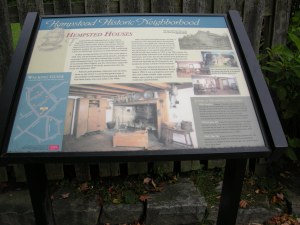
NewLondonEtc10-09 021

Now, back to the Customs House.  Oh my.  1833 – beyond the period of our usual interest in architecture, but the history is wonderful.  As wonderful as the docents who greeted us inside.  Ruth was kind and apologetic about the temperature which she found frigid – the furnace was on the blink.  Someone was working on it.  I thought, how nice, the full experience of the building in 1833 – no heat.  But it was soon working, and cooking us!

NewLondonEtc10-09 026

The front doors, she explained, had been fabricated from planks donated during the restoration of Old Ironsides in the 1830’s.  I had to go back out and touch them!  We’re hardly in the entrance and we’re “entranced” already.

We had just wanted to breeze through without a tour, to take what we could of the architectural elements, but found ourselves lingering at the door listening to the docent who had just finished a tour.  This is the oldest continuously operating customs house in the country as the US Customs service still maintains an office there.  For two people who wanted to rush through, we instead found ourselves spending over an hour in the hallway and one front room!  The docent was so knowledgeable and our questions were endless.  Customs made our government go round back then – there were no taxes – they paid for everything!  How and when and why it worked, how it evolved to become the Coast Guard, was fascinating, but our time there was limited.  My husband reminded me we were burning daylight, there was much else to do and a sailboat to see.  We will be returning soon for a full tour with Bill – a gentle & informative Customs House docent, who is steeped in stories and knows how to tell them.  Having heard my story that the places we had intended to visit were closed, he assured me that the Customs House was open every day except Monday, with tours from 1 to 4.   There was something very comforting in that, knowing that he and Ruth and whoever is responsible for maintaining that building and all its history, would be there to welcome us back, anytime.

Here are some photos of the Customs House, and the plaque in front with facts about its Amistad connection.  I don’t want to give away too much information – you must visit!
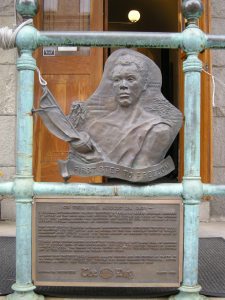
NewLondonEtc10-09 028NewLondonEtc10-09 029

Also, I had noticed a small gambrel a few buildings away, which Bill mentioned that if we look to its left, in the alley, we’ll see that it still retains its old cobblestones.  The poor gambrel has restaurant fans and vents and other cooking artillery and heating paraphernalia sticking out of it.  We wished we had a billion dollars to buy it all up, the whole street, rid it of blight and bring it back to its whaling days!

Let’s all buy lottery tickets just for that purpose.  If we buy a few thousand, and win – heck, we could rebuild a city!

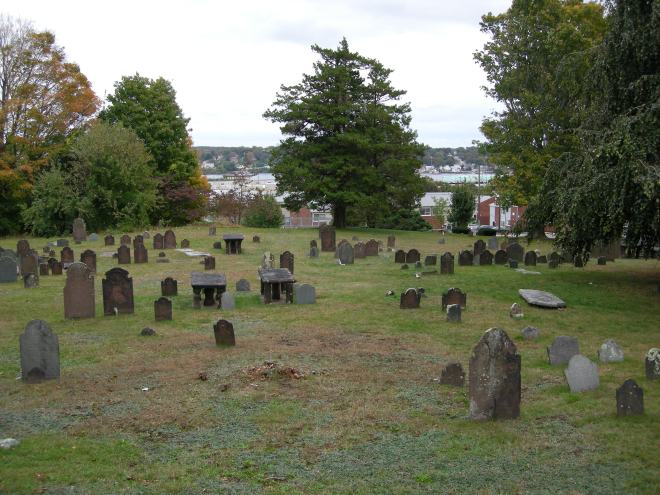
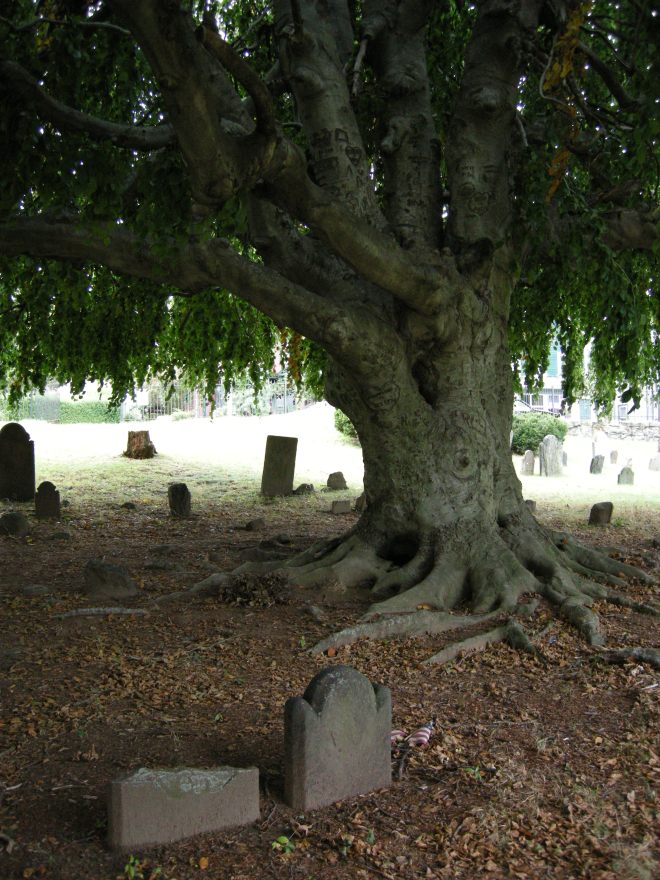
Some photos of Bank Street and the “Antientest Buriall Place” in New London.  It is said that Benedict Arnold stood on the knoll of that burial ground and watched the British burn the city and attack Fort Griswold just across the river in Groton.   Fort Griswold is also worth a visit.  It is a park now, with the remains of this Revolutionary War fort with Civil War additions and an 18th century house where those wounded in the battle were cared for.
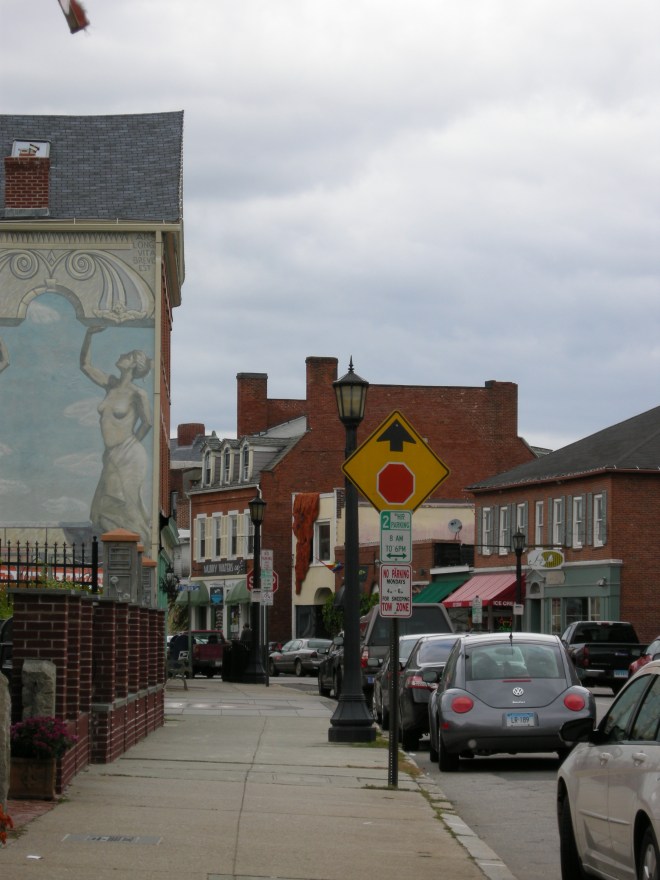
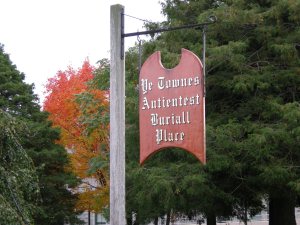
NewLondonEtc10-09 035NewLondonEtc10-09 034NewLondonEtc10-09 039

a find

Sometimes you just can’t wrestle that dilapidated old house from the grip of an indifferent owner.  Whether it’s falling down or falling apart – they don’t care.  They may have inherited the property with an eye toward one day tearing it down and building a new one on the same spot.  Or may be considering it as a project for the future, and don’t want to think about it right now.  Sometimes, it’s just that it’s theirs, and it’s none of your business.  There are as many reasons for it as there are arguments among siblings who’ve inherited a house.

Once, we came across a lovely old place in a terrible location, close to a commercial thoroughfare.  It was next door to a gas station, and behind it were the remains of a working farm.  A few weathered barns, in various states of disrepair, struggled to maintain the ambiance of a long forgotten past.  Corn grew and cows grazed in the pasture beyond.  Settings like this attract us, and the abandoned old house is the magnet that draws us in, beckoning us to explore and yes, sometimes, to trespass in the name of preservation.

The front door of this one had been left ajar, and there wasn’t a soul around.  It was an early farmhouse with a steep pitch to its crooked roof, wide center chimney with a few missing bricks, and what looked like original windows with crown glass.  It was now dressed in asbestos siding, and some vinyl storms, but the overall shape still stood proud.

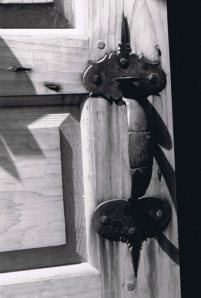
The front door’s raised panels were cracked and weathered, but repairable.  Iron strap hinges were still in place, as well as the arrowhead latch.  It groaned stubbornly across a swollen plywood landing as we swung it open.  We expected to step into the original front porch, with dog leg staircase and doorways to either side.  And that is exactly what we did.  The old staircase twisted steeply to the second floor, displaying its early turned balusters, newel post and simple handrail.  The unpainted treads were shallow and dry, worn thin in the middle from a thousand climbs to the second floor.  The thin whitewashed plaster that lined the stairwell was barely clinging to the lath beneath and was falling in clumps onto the stairs.  The entire wall in front of us was beautifully paneled, with a door to the basement, and a sparking bench between.  Musty and mildewed, cobwebbed and dirty, the entire space was a treasure.

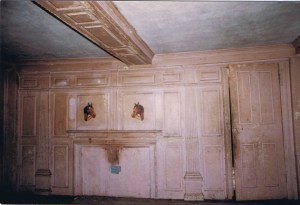
We turned to walk through a doorway to the front room, but stopped in the nick of time.  There were no floors, on either side.  No first floors, no second, and no third!  Wanting to get a better view of the fireplaces, we walked across the joists, carefully, trying not to fall into the basement.  The fireplace walls, at the first and second floors, were paneled, one with a built in cupboard to the right of it.  The summers were cased, there was crown moulding around the perimeter, and wainscoting below.  All the treasures you hoped to find in an early house.  But where was the flooring?  Obviously, someone had been there before us, and had either stolen it, or had made a deal with the owners to buy it.  Surely they would be back for the rest.

While we are known to trespass in abandoned old houses, we have never removed anything from them.  Like the old birdwatcher’s motto – take a few pleasures, leave a few footprints – we have a thorough respect for their dignity, and desire only to examine and evaluate, to find a way to improve their situation, and to keep them whole.

We found the owners – two brothers who lived in town, and visited daily to tend the farm.  It turned out that they had sold the flooring, but were not interested in selling anything more.  We were glad to hear that, as it is always a shame to “part out” a house.  However, as it turned out, they wanted the rest of it to remain because it housed the water pump in the basement. This once proud homestead, replete with 18th century millwork treasures, was now a pump house.  No amount of coaxing could move these old Yankees into giving up the house.  We offered to build a more efficient shelter to cover their pump.  No luck.  We asked if we could purchase the paneling – for safekeeping, in the event that they might change their minds, or at the very least, to keep it from being stolen.  Not interested.  We asked if they might put a lock on the front door to prevent the house from being vandalized.  That was inconvenient.

We drove by once in a while after that, to see how the house was faring.  At each visit we’d notice parts missing, one wall of paneling gone, then another.  Then a hole where the built-in cupboard used to be.  The paneled door to the basement, easily lifted off its pintels, gone.  Paneling and sparking bench, all stolen.  Even the floor joists were missing.  We pleaded with the farmers, but their stubbornness prevailed.

Then the dreaded day came when we drove by only to find charred remains of the treasure that used to be.  I can’t remember how it happened, but didn’t matter, it was gone, another waste.

This wouldn’t be the only story of its kind in our travels.  There were many.  But they weren’t all losses.  Some, thankfully, we would win.

the forgotten

As young college students, some forty years ago, we were on one of our old house adventure drives between southeastern MA, RI and CT.  What used to take two hours to get from college to home now became four or five as we detoured endlessly in our effort to “discover” every old house on our route – to admire, to learn from, and perhaps to find some derelict we could fix.  On this day, we wound our way up some forgotten back road lined with moss covered stone walls, overhung with mature maples.  Their leafy arms arched over the road from both sides, blocked out the sun and created one of those sepia scenes in an old daguerreotype.   There were no homes, no development, just woods.  The kind of place where you feel you’ve stepped into the past, because nothing has changed, it’s as it always was.  We hoped to find an old saltbox, or simple farmhouse or cape at the end.  If someone lived there, maybe they wouldn’t mind our stopping by to admire it.   They might even offer to let us in, to share their “labor of love” as so many called it.

And then we came to the end.  It was a little clearing, overgrown with bushes and vines.  The sun streamed through the trees in a biblical light.   There it stood, directly in front of us, a grand stone chimney, some thirty feet high, fireplaces exposed up to the second floor with no way to reach them.  The bones of the old frame struggled to outline where the house used to be.  The rest of it, from floor joists to ridge pole, had collapsed into the cellar hole.   Girts, purlins, sills, and summers stuck out of the earthen pit like a grand carcass, licked clean by the twin vultures of neglect and time.   Squirrels scrambled along the fallen joists, birds scattered to the top of the chimney, where surely bats slept within.   Saplings sprouted in the damp, dirt basement, weeds and vines emanated from every crack in the foundation stones, and a giant walnut tree spread above, dropping its walnut harvest for the creatures that scampered everywhere.   The scene was bittersweet.  Another piece of history was lost, but in that loss, nature was reclaiming her own.

+

forgotten

So many houses have been lost to neglect, in our own back yard, in our own historic neighborhoods.  The only way to view them now is in books or historical archives.  We regret their loss, but we can’t always blame the owner for it.  A neighbor, who had lived through the depression, pointed out to me that during that difficult time people just didn’t have the money to fix up these old places.  Sills rotted, houses leaned, roofs decayed.  What was one to do?

We can only do our best.  Maintenance is an issue with anything made of wood and exposed to weather.  Our early homes need a lot of help, more than new ones, but they’re worth it.  If we keep them oiled and painted, and repair or replace anything cracked or broken on a regular basis, if we care for them, they will last another two hundred years.  But abandoned, there is no hope, unless adventurers like us continue on our prowl to find them in time to save them from the compost heap.

progress?

So many, moving so fast, in the name of progress.  Yet where are we going?  Some of us chasing our tails, some striving for an unknown beyond.  So many take no notice of what surrounds them.  “Architecture is frozen music,” said Goethe.  We need to stop, now and then, and listen.  The notes are carefully crafted around us in small forms – a beading detail on a window frame, a bolection moulding around a fireplace opening, a paneled wall at a chimney breast, wainscoting, raised paneled or plank, with chair rail above, a corner cupboard built in to the corner of the room to house our precious things.   The curve of the shelf, the scallop of the back, the hand forged brass knob – all carefully considered, hand worked and forged with a pride that could carve a country out of a wilderness.

Yet, how ungrateful we have been.   How could we turn a blind eye to what these craftsmen created?  How could we forget the awe of their achievement?

We have strayed far.  Hundreds, thousands, dare I say, millions, of houses have been built since, without even a cursory nod to classical design.  They want to learn nothing from the past, just to rewrite it.  To pick it clean, selectively, according to their likes and dislikes, and mold it together as economically as possible, into one giant monolith.   And most builders cater to this.  They look only forward, never back.  Forward to the profit margin, to the devil with the result.  Thus, we have miles of plastic cities, plastic neighborhoods, plastic homes.  With wide empty spaces in which to lose dreams instead of create them, slippery spaces where nothing can stick, Teflon walls, padded floors, plastic paint.

Where is the pride in that?  Where, the reality?

Our American treasures, large and small, cannot be forsaken.   We cannot leave this work only to Landmarks Societies or Historic District Committees, their budgets and powers are limited.  We each have to do our small part, whether it’s saving, instead of knocking down, or calling in an expert for advice on how to restore, repair, reshape the old doorway, the sagging floor, the crooked windows.  There is help and expertise out there.  But one has to make the call.  One has to care.

How I wish I could have been with Henry James on his travels in 1904!  When the roads were still dirt, travel was horse and cart, and architecture so simple.  Before the advent of asbestos and aluminum siding, insulated windows and asphalt roofs!  When glass was wavy and doorways were made of wood.  When architects like Christopher Wren and Asher Benjamin based their designs on the classical, craftsmen honed their skills with pride, and town folks built their homes, and their lives, on principles.

We can do this again.  We need to slow down, turn our attention to the classical details that have outlasted all fads, to the places that have drawn tourists and students alike for a thousand years, and listen, ever so carefully, to the frozen music.

colonial homes

Obviously, a lot has changed in two hundred years, but American’s love for their colonial history and architecture has remained steadfast. As evidenced by preserved villages such as Sturbridge, Deerfield, Greenfield, Strawberry Banke and Williamsburg, and the hundreds of homes maintained by local historical and landmarks societies, colonial New England architecture is alive and well in the hearts and minds of Americans.

At first glance one notices the well designed façades, hefty proportions, the graceful balance and detail of the New England home.  The carved doorway, small paned windows, and smoke rising from the chimney beckon us to come inside and stay a while.  Henry James in 1904 while traveling through our fair New England, noted in the American Scene, “Look at them…at the fine old liberal scale, and felt symmetry, simple dignity, and solid sincerity of them…”

So why, you wonder, have we strayed?  Why has the countryside been littered with other than perfectly proportioned New England colonials? Where corn and tobacco used to grow, houses have been planted from a seed-book of generic plans that offer up what the builder believes will sell – space, convenience, economy.  Without a care for aesthetic, or for what history has taught us to please the eye and comfort the soul, proportion and balance is thrown out of the too tall pseudo Palladian window with the snap in grills in favor of ease and carefree living.

To say that a lot has changed in the last hundred years, architecturally, is an understatement.  Through the colonial revival period of the 20th century, designing homes was still an art, and adherence to aesthetic principles was still the rule.  The late 20th into the early 21st century has produced an abundance of ruthless architecture, the type that serves up to its buyers everything they could possibly want.   Space, lots of it, high ceilings, large bathrooms with whirlpool tubs, perhaps a slate foyer, and an indoor pool.  The rule became – give them what they want on the inside, and adjust the outside accordingly.  The designer may have done his/her best, given their training, to produce an aesthetically pleasing home, but once left to the interpretation of the builder and homeowner, who are left to select for themselves all of the details they ever dreamed of incorporating into their home – well, the apple ends up falling very far from the tree.  Sometimes it ends up a kumquat!

It reminds me of a story I used to read to my children, about a little bear who draws a picture of his mother at school.  On his way home he shows the picture to his friend, the alligator, who says the mouth is too small.  So he makes it larger.  Then he meets his friend the elephant, who says the nose is too short.  So he makes it longer.  Then he meets the giraffe, who says the neck should be taller, and so on.  You can imagine the picture by the time he gets home.  But of course, his mother loves it!  And, I suppose, from the inside of the house, the homeowner who got everything they ever wanted in their house, will love it too.  But from the outside, it’s probably hard to tell which is the front, the side, or even, which way is up!

This is alright for the fast lane folks, I guess, where a house is just a house, a place to get it done. But some of us want to move slower, savor every moment.  To some of us, it all matters.  We want to envelop ourselves in the hand made, where we can caress the paneling, admire the hand carved mouldings, ponder the past over a grand hearth.  We want to walk across old pine boards, open real wood doors, lift an iron latch.  We long to gaze out of small paned windows with wavy glass.  We yearn to enjoy the simple elegance of the colonial house, grounded in history and constructed by hand.